
Series: The Numbers Behind Your Business — Part 10 of 15
When Carlos’s accountant set up payroll for the S corp, he reviewed how Carlos pays everyone who works with him. He found something that’s very common in construction.
Besides his 10 employees on payroll, Carlos has two more workers, Yoandry and Luis, whom he pays as independent contractors. He gives them a 1099 at year-end and withholds nothing. Each earns about $45,000 a year.
“It’s cheaper that way,” Carlos explained. “And they’d rather get paid in full.”
The accountant asked him a few questions:
Do they work only for you? Yes.
Do you tell them what time to show up and what to do? Yes.
Do they use your tools and your truck? Yes.
Do you pay them by the hour or the week, not by finished job? By the week.
Do they have their own company, license, and insurance? No.
“Carlos,” the accountant said, “to the IRS, Yoandry and Luis are your employees.”
It’s not what you decide, it’s how the relationship works
Many owners think it’s enough for the worker to agree, or to sign a contract that says “independent contractor.” It isn’t. What counts is how the relationship works in practice.
The IRS looks at three groups of factors:
Behavioral control. Who decides how, when, and where the work gets done? If you give the instructions and supervise, that points to employee.
Financial control. Who provides the tools and equipment? Can the worker make or lose money on the job? Do they work for other clients? If they’re paid by the week with your tools, that points to employee.
Relationship of the parties. Is it an ongoing relationship? Is the work a core part of your business? If so, that points to employee.
No single factor decides it. The whole picture matters.
What about the electrician and the plumber?
His accountant also reviewed the subcontractors Carlos uses on his jobs: the electrician and the plumber. They really are independent contractors: they have their own companies, licenses, and insurance, they work for several contractors, they use their own tools, and they invoice Carlos per finished job.
The difference isn’t the trade. It’s how they work.
In Florida, there’s also workers’ comp
In Florida, any construction business with even one employee must carry workers’ compensation insurance. And there’s more: if a subcontractor doesn’t have its own coverage, its workers are considered the contractor’s employees for purposes of that insurance.
That means if Yoandry falls off a ladder on a job, it’s Carlos’s problem, 1099 or not. That’s why you should get a certificate of insurance from every real subcontractor before each job starts.
What does it cost to fix, and what does it cost not to?
If Carlos puts Yoandry and Luis on payroll, he has to pay the employer share of payroll taxes and unemployment, plus workers’ comp. If he doesn’t, and the IRS catches it in an audit, it collects the taxes for prior years.
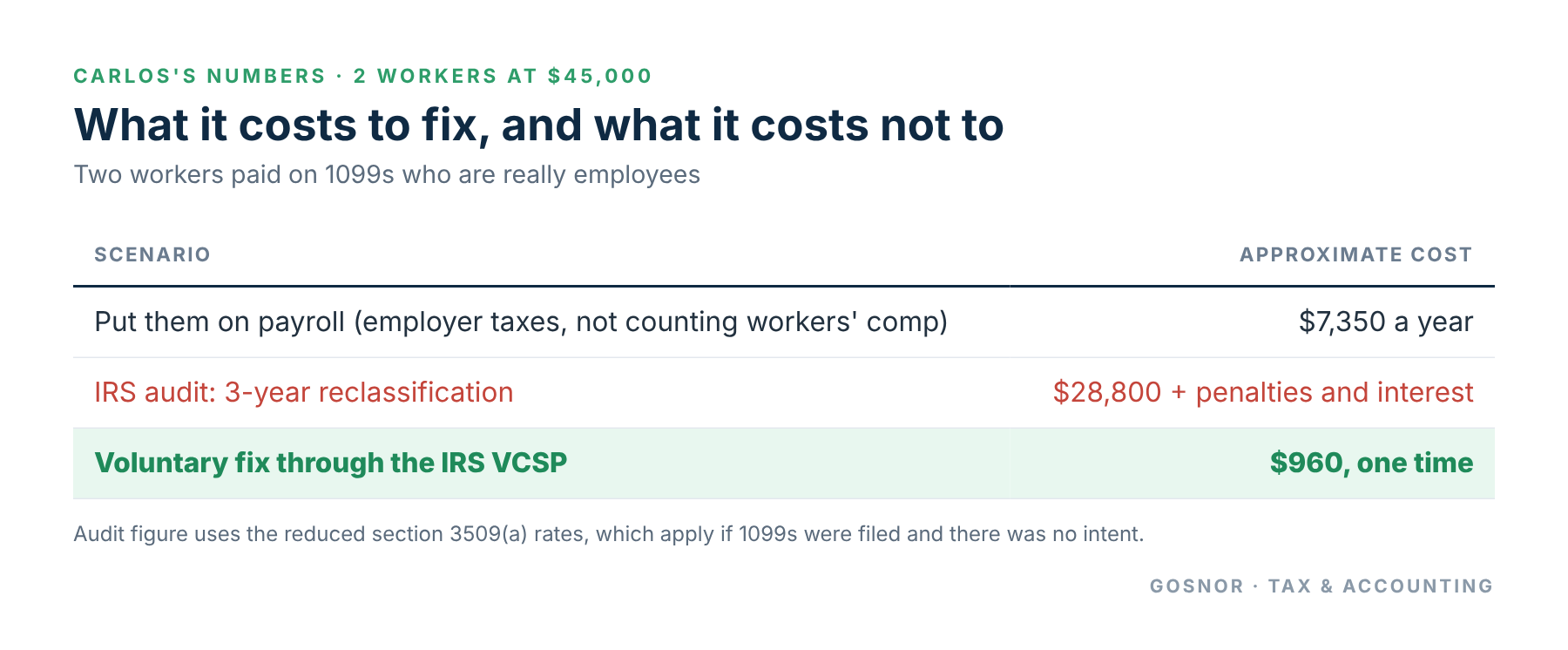
The audit figure uses the reduced rates the IRS applies when the misclassification was a mistake rather than intentional, and when the business did file the 1099s. If the 1099s weren’t filed or the IRS finds it was intentional, the bill goes up considerably. And that’s just the IRS: Florida reemployment tax and workers’ comp can bring their own bills.
The program almost nobody knows about: VCSP
The IRS has a program for businesses to fix classification on their own, before they get audited. It’s called the Voluntary Classification Settlement Program (VCSP). Here’s how it works:
You pay 10% of what you would have owed in payroll taxes for those workers in the most recent year, calculated at the reduced rates.
No interest or penalties.
The IRS won’t audit that classification for prior years.
From then on, you treat them as employees.
To qualify, you must have filed 1099s for those workers for the past three years and not be under an employment tax audit by the IRS, the Department of Labor, or the state. The application, Form 8952, has to be filed at least 120 days before the date you start treating them as employees.
What did Carlos decide?
Carlos had filed 1099s for Yoandry and Luis every year, and he’s not under audit. With his accountant, he filed the VCSP application in November to move them onto payroll starting March 1, 2027, meeting the 120-day notice. They now cost about $7,350 more a year, not counting workers’ comp, but Carlos sleeps well.
And with the electrician and the plumber, he did three things: he got their Form W-9, a current copy of their certificate of insurance and license, and made sure to file their 1099-NECs on time, by January 31.
So what now?
If your business has people paid on 1099s who work like employees, this isn’t something to put off. The sooner you fix it, the cheaper it is.
Next in the series: With everyone on payroll, Carlos will be handling more payroll taxes than ever. We’ll see why that’s the most dangerous debt a business owner can have: the kind that can become personal.
Do you have workers on 1099s and aren’t sure whether they should be on payroll? At Gosnor, we review your situation and help you fix it before it becomes a problem. Book a free consultation.
Lee este artículo en español: ¿Empleado o 1099? El error de clasificación que más le cuesta a los contratistas
