
Series: The Numbers Behind Your Business — Part 9 of 15
At the end of the last article, Carlos asked his accountant a very logical question: “If payroll taxes only apply to salary, why not pay myself less? At $30,000, I’d save a lot more.”
His accountant answered with a story.
Rubén’s story
Rubén has been Carlos’s friend for years. He owns a roofing company with similar profit, about $200,000 a year, and he’s also an S corp. Three years ago, someone told him the smart move was to pay himself a low salary and take the rest as distributions. So he set his salary at $30,000.
Rubén runs his crews, prices jobs, buys materials, and handles clients. He works more than 50 hours a week in his business.
Last year, the IRS audited his S corp. It looked at what Rubén does, how many hours he works, and what another company would pay someone to do that job. It concluded that a reasonable salary for him was about $85,000, and it reclassified the difference as wages.
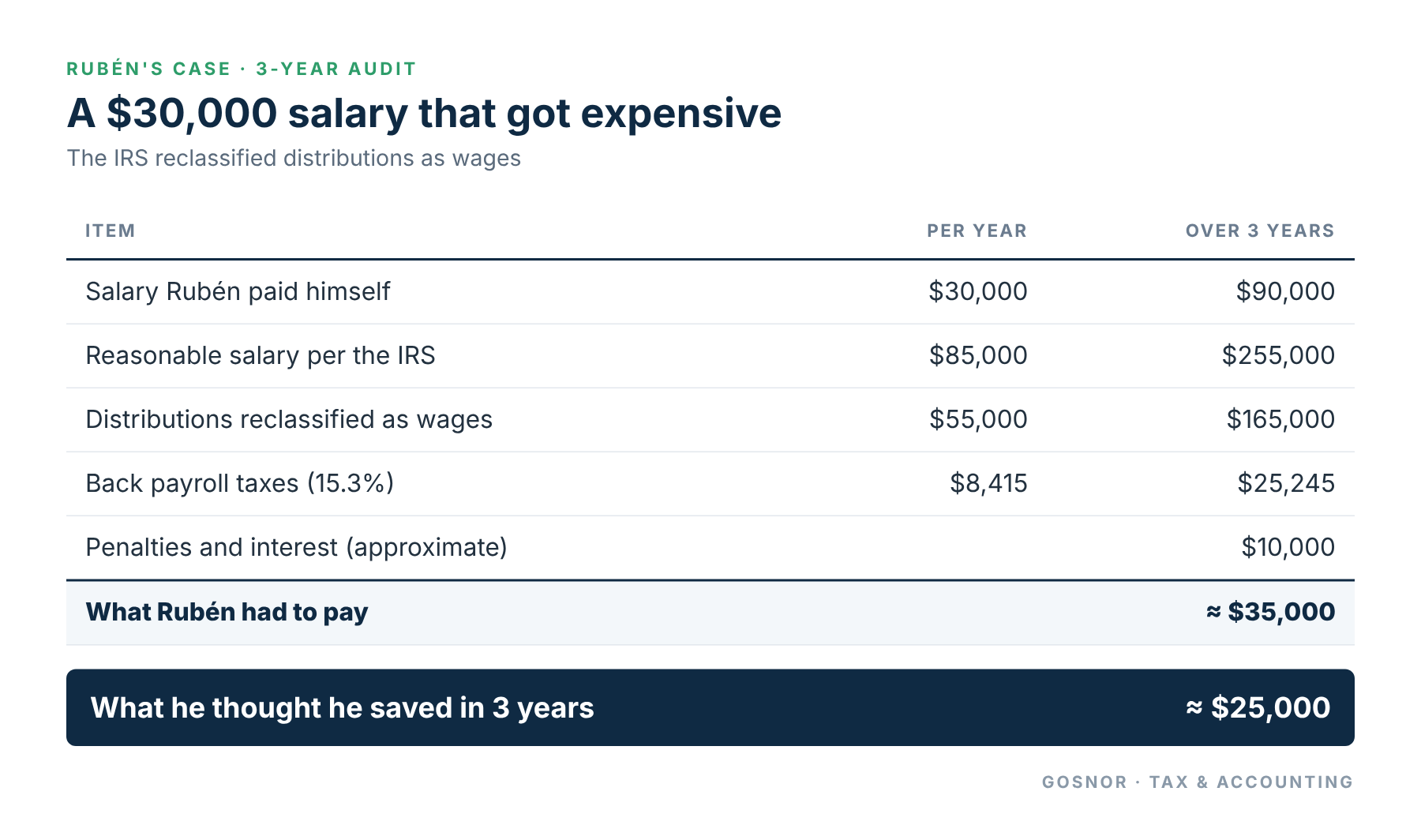
Rubén thought he was saving about $8,400 a year in payroll taxes. Over three years, that came to about $25,000. He ended up paying about $35,000, plus what it cost him to defend the audit.
Rubén’s story is an example, but it happens in real life. In a well-known case, Watson v. United States, a CPA paid himself a $24,000 salary and took between $175,000 and $200,000 a year in distributions. The IRS determined his reasonable salary was about $91,000, and the appeals court sided with the IRS in 2012.
What is a reasonable salary?
There’s no exact formula. The question the IRS asks is simple: how much would you pay someone else to do your job?
To answer it, the IRS and the courts look at factors like these:
Your training and experience.
Your duties and responsibilities.
The time you devote to the business.
What you pay employees who aren’t owners.
What similar businesses pay for similar services.
How much you take in distributions compared to your salary.
And one myth worth clearing up: the famous “60/40 rule,” which says salary should be 60% of profit, doesn’t exist in the law. It’s a rule of thumb some people use, but the IRS doesn’t recognize it. What counts is what your work is worth.
The most expensive trap: no salary at all
There’s something even worse than a low salary: no salary.
Some owners elect S corp status and never set up payroll. They take everything as distributions. If the owner works in the business, the IRS can reclassify all of those distributions as wages, and also charge penalties for never filing payroll returns and W-2s.
In that case, the S corp doesn’t save anything. It becomes a debt that grows every year.
How Carlos defended his $85,000 salary
Carlos doesn’t want to end up like Rubén. With his accountant, he documented his salary before starting:
He described his job in writing. Roughly 60% management, pricing, and clients, and 40% on-site supervision.
He compared it to real data. According to the Bureau of Labor Statistics (BLS), a construction manager earns an average of about $122,000 a year in the Miami area, and about $81,000 at the low end of the national range. Carlos’s $85,000 is in a defensible range for the size of his business.
He put it in writing. Annual minutes or a memo with the salary, the reasoning, and the data he used.
He actually pays it. Through payroll, every two weeks, with withholding. Distributions come after.
He reviews it every year. If the business grows and Carlos earns more, his salary has to go up too.
So what now?
A reasonable salary isn’t the lowest one you can get away with. It’s the one you can defend. An S corp saves money when it’s done right, and costs a lot more when it’s done wrong.
Next in the series: Now that Carlos will be running payroll, his accountant reviewed how he pays his crews. Two of his workers are on 1099s. Are they really independent contractors? We’ll talk about the classification mistake that costs contractors the most.
Would your salary as an S corp owner hold up to an IRS review? At Gosnor, we help you calculate and document it. Book a free consultation.
Lee este artículo en español: Salario razonable: lo que el IRS revisa en una S corp y la trampa más cara
