
Series: The Numbers Behind Your Business — Part 7 of 15
In mid-November, Carlos’s accountant asked him a simple question: “How much have you paid the IRS this year?”
Carlos thought about it. “Nothing. I pay in April, when I file.”
It’s a very common answer. And it has two problems. The first is how much he’s going to owe in April. The second is that the IRS doesn’t wait until April.
How much will Carlos owe?
In the last article, we saw that Carlos pays taxes on all of his LLC’s profit: about $190,000 in 2026. His accountant ran a rough calculation, assuming Carlos is married, files jointly, takes the standard deduction, and has no other income or credits:
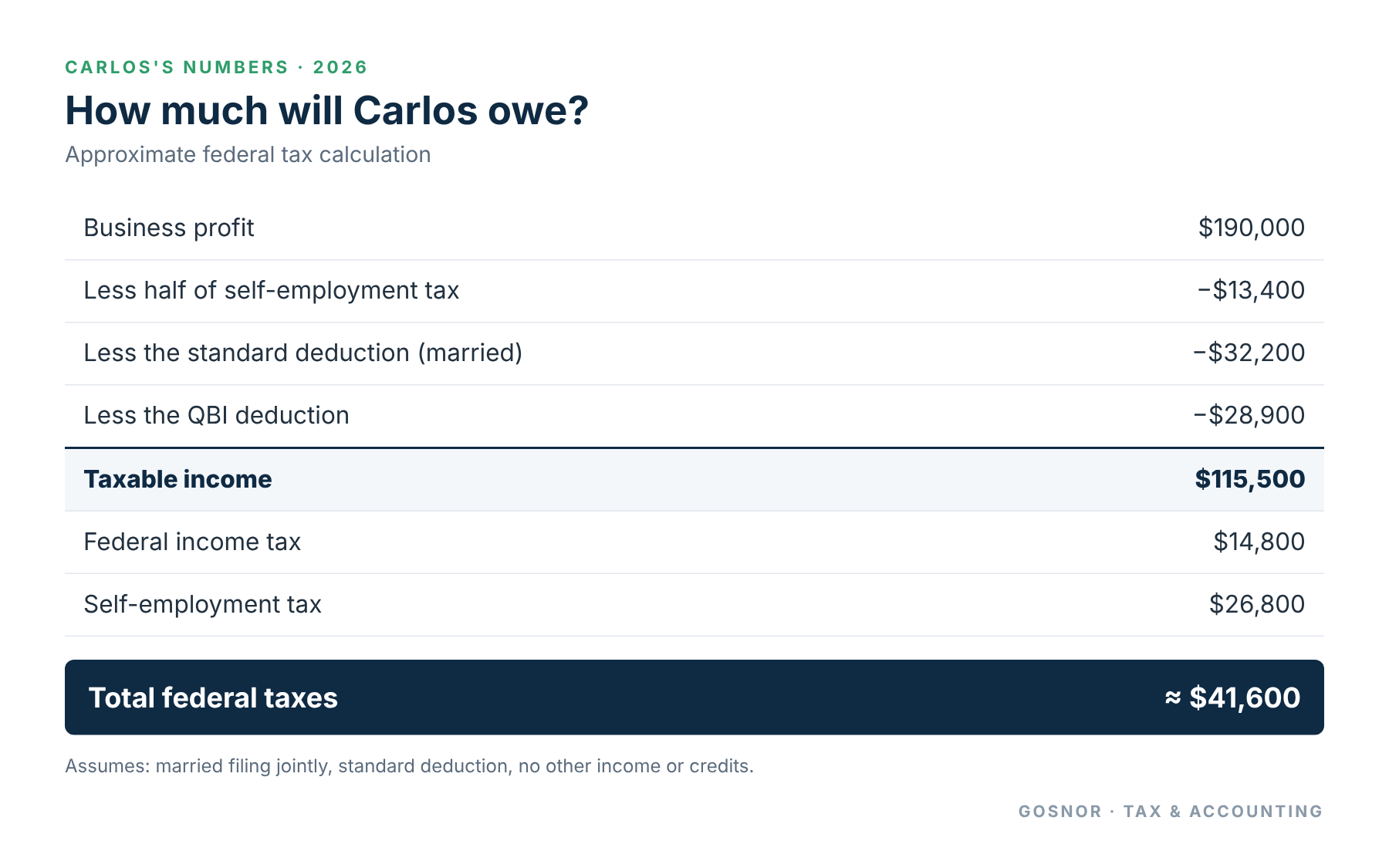
About $41,600, roughly 22% of his profit. And Carlos hasn’t set anything aside.
Remember how November ended? With $23,000 in the bank, after putting in $10,000 of his savings to cover payroll.
The IRS doesn’t wait until April
Employees pay their taxes a little at a time: their employer withholds it from every paycheck. But nobody withholds anything for Carlos. That’s why the law requires him to pay during the year through estimated taxes, on four dates:
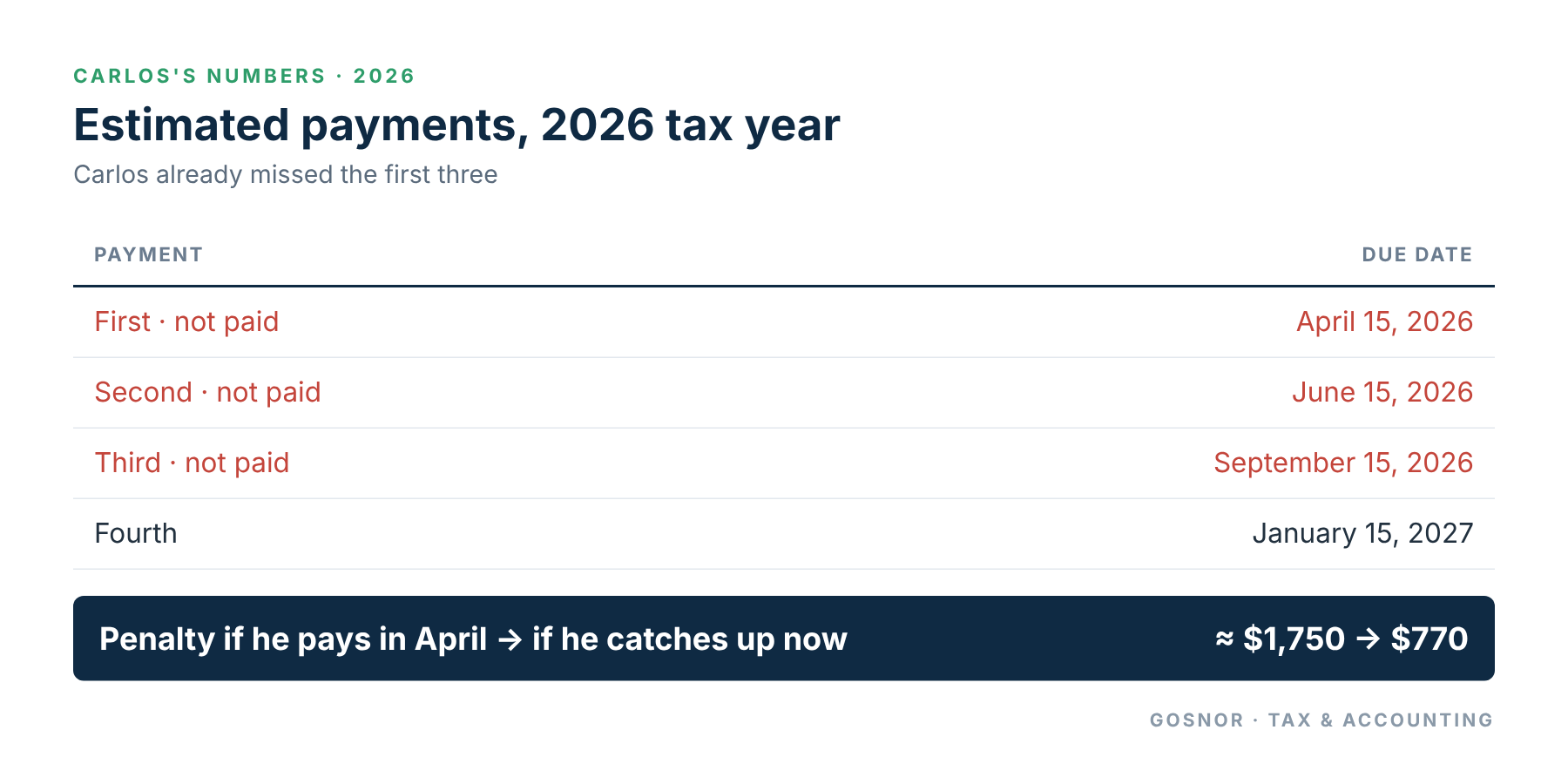
Carlos has already missed the first three.
The penalty nobody explains
If you skip estimated payments, the IRS charges an underpayment penalty. It works like interest: it’s calculated on each payment you missed, from the date it was due until the day you pay. The IRS sets the rate every quarter, and right now it’s 7% a year.
For Carlos, each quarterly payment should have been about $9,400. If he waits until April to pay it all, the penalty would be about $1,750. If he catches up now, in November, and makes the January payment on time, the penalty drops to about $770.
That’s not a number that sinks anyone. But it’s money paid for not planning. And the penalty is the least of it: the real problem is having to come up with $41,600 all at once.
How to avoid the April surprise
The law gives you a way to protect yourself from the penalty, even if you end up owing more than you expected. It’s called the safe harbor: there’s no penalty if your estimated payments for the year add up to at least one of these two amounts:
90% of this year’s tax, or
100% of last year’s tax. If last year’s adjusted gross income (AGI) was over $150,000, it has to be 110%.
With that, a simple plan:
Figure out your payments at the start of the year. Using last year’s return and a projection for this year, your accountant tells you how much to pay each quarter.
Use the tax account from the last article. Every month you transfer a percentage of profit. When the due date comes, the money is already there.
Review the projection in June and September. If the year is going better than expected, adjust the remaining payments.
Pay online. The IRS has options to pay directly from your bank account, and you keep the confirmation.
In the last article we suggested setting aside 25% to 30% of profit. Carlos came out at 22% thanks to the QBI deduction and the standard deduction. That extra margin is your cushion: it’s better to have money left over in April than to come up short.
So what now?
If you own a business and haven’t made estimated payments this year, there’s still time to shrink the problem. The fourth payment is due January 15, and catching up before then lowers the penalty.
Next in the series: With $41,600 in taxes on the table, Carlos wants to know whether an S corp makes sense for him. We’ll run the full numbers: how much he saves, what it costs, and when it isn’t worth it.
Not sure how much you’ll owe in April? At Gosnor, we calculate your estimated payments and help you catch up before January 15. Book a free consultation.
Lee este artículo en español: La sorpresa de abril: cuánto vas a deber, los pagos estimados y la multa que nadie te explica
