Series: The Numbers Behind Your Business — Part 6 of 15
Ask Carlos how much he makes and he has to think about it. “Depends on the month,” he says. When he needs money for the house, the car, or a trip, he transfers it from the business account to his own. Sometimes it’s $3,000. Sometimes it’s $17,000, like in October. Some months he takes nothing because “things are tight.”
That way of paying yourself has a name: the owner’s draw. It’s completely legal and very common. But it has consequences most owners don’t know about.
First: why doesn’t Carlos have a salary?
Carlos has a single-member LLC. For the IRS, unless he elects otherwise, that kind of LLC doesn’t exist as a separate taxpayer: the business’s profit is reported directly on Carlos’s personal return.
That means Carlos can’t be an employee of his own LLC. He can’t put himself on payroll or receive a W-2. The only way to take money out is through draws.
The most expensive misunderstanding: you’re not taxed on what you take out
Many owners believe they pay taxes on the money they bring home. That’s not how it works. With a single-member LLC, you pay taxes on all of the business’s profit, whether you take it out or not.
Here’s Carlos’s year:
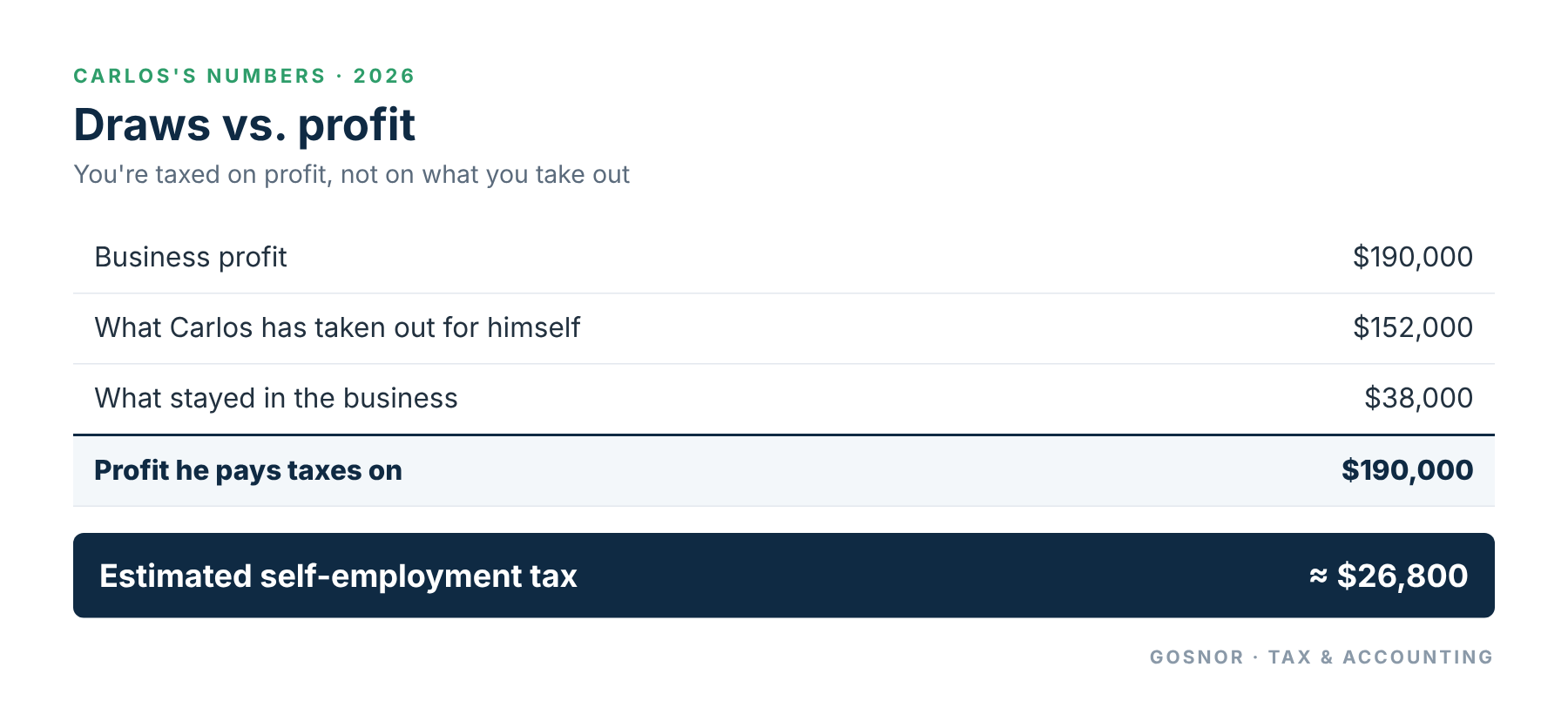
Even though $38,000 stayed in the business (in materials, receivables, the truck), Carlos pays taxes on the full $190,000.
And there are two taxes:
Federal income tax, based on his bracket.
Self-employment tax, which is Social Security and Medicare for the self-employed: 15.3% on almost all of the profit, up to an annual cap for the Social Security portion. In Carlos’s case, it’s about $26,800.
Neither one is being withheld. Nobody takes anything out of his draws. If Carlos isn’t setting money aside for those taxes, the bill arrives all at once.
Three problems with taking money out “when you need it”
1. You take money that isn’t yours. If you look at the bank balance to decide how much to take, you can end up taking a client’s deposit or the payroll tax money. That’s exactly what we saw in the first article.
2. You don’t know if the business can pay what you need. If you take $17,000 one month and nothing the next, you never know what your life costs or whether the business can support it.
3. You don’t set money aside for taxes. And as we saw, taxes are based on profit, not on draws.
A better way to pay yourself
You don’t need to change your structure to pay yourself better. You need a system:
Set a fixed “paycheck.” Figure out what you need to live on and take it on the same date, every two weeks or every month. For Carlos, for example, $4,000 every two weeks. It’s still a draw, but now it’s predictable.
Set aside taxes every month. A separate account, just for taxes, where you transfer a percentage of each month’s profit. For many owners, 25% to 30% is a good starting point. Your accountant can give you the exact percentage.
Take the rest quarterly, after reviewing the numbers. When you close each quarter, look at real profit, your reserve, and your cash flow projection. If there’s extra, take an additional draw.
Record your draws as draws. Not as business expenses. If they get mixed in, your P&L stops telling the truth.
The question that leads to an S corp
When Carlos saw the $26,800 in self-employment tax, he asked what almost every owner in his position asks: “Isn’t there a legal way to pay less?”
The answer is: there may be. If his LLC elects to be taxed as an S corporation, Carlos can put himself on payroll. He’d pay himself a reasonable salary for his work, with payroll taxes like any employee, and receive the rest of the profit as distributions, which aren’t subject to Social Security or Medicare tax.
With profit like Carlos’s, the savings could be several thousand dollars a year. But it’s not as simple as it sounds: an S corp has costs, strict rules, and a big risk if the salary isn’t reasonable or the books aren’t in order. We’ll cover all of that in Articles 8 and 9.
So what now?
Before thinking about an S corp, the first step is to pay yourself with a system: a fixed paycheck, a tax account, and extra draws based on real profit, not the bank balance.
Next in the series: Carlos hasn’t set anything aside for taxes this year. We’ll see how much is coming in April, what estimated payments are, and why the IRS charges a penalty if you skip them.
Do you know how much you can pay yourself without putting your business at risk, and how much to set aside for taxes? At Gosnor, we help you build your plan. Book a free consultation.
Lee este artículo en español: ¿Cómo te pagas a ti mismo? Owner's draw, salario y la pregunta que lleva a la S corp
