
Series: The Numbers Behind Your Business — Part 12 of 15
Every December, Carlos hears the same advice. His brother-in-law says it, the salesman at the dealer says it, and social media repeats it: “Buy a truck before the 31st and you won’t pay taxes.”
This year the advice sounded better than ever. In article 7 we saw that Carlos will owe about $41,600 in federal taxes for 2026. A new truck for the business costs about $65,000. Wouldn’t it be better to give that money to the dealer than to the IRS?
Before signing, he asked his accountant.
First: what is depreciation?
When you buy something that will last several years, like a truck, a machine, or a computer, you usually can’t deduct the whole cost in the year you buy it. You deduct it little by little, over its useful life. That’s depreciation. A work truck, for example, is depreciated over about five years.
But the law has two shortcuts that let you deduct almost all of it in the first year:
Section 179, which lets you deduct the cost of business equipment and vehicles all at once, up to a very high limit.
Bonus depreciation, which today allows a 100% first-year deduction for most equipment acquired after January 19, 2025.
For a work truck with a gross vehicle weight rating over 6,000 pounds, like the one Carlos needs, that means he can deduct the full $65,000 in 2026.
How much does he really save?
Here’s what nobody tells you at the dealer. His accountant ran the numbers using the same figures from article 7:
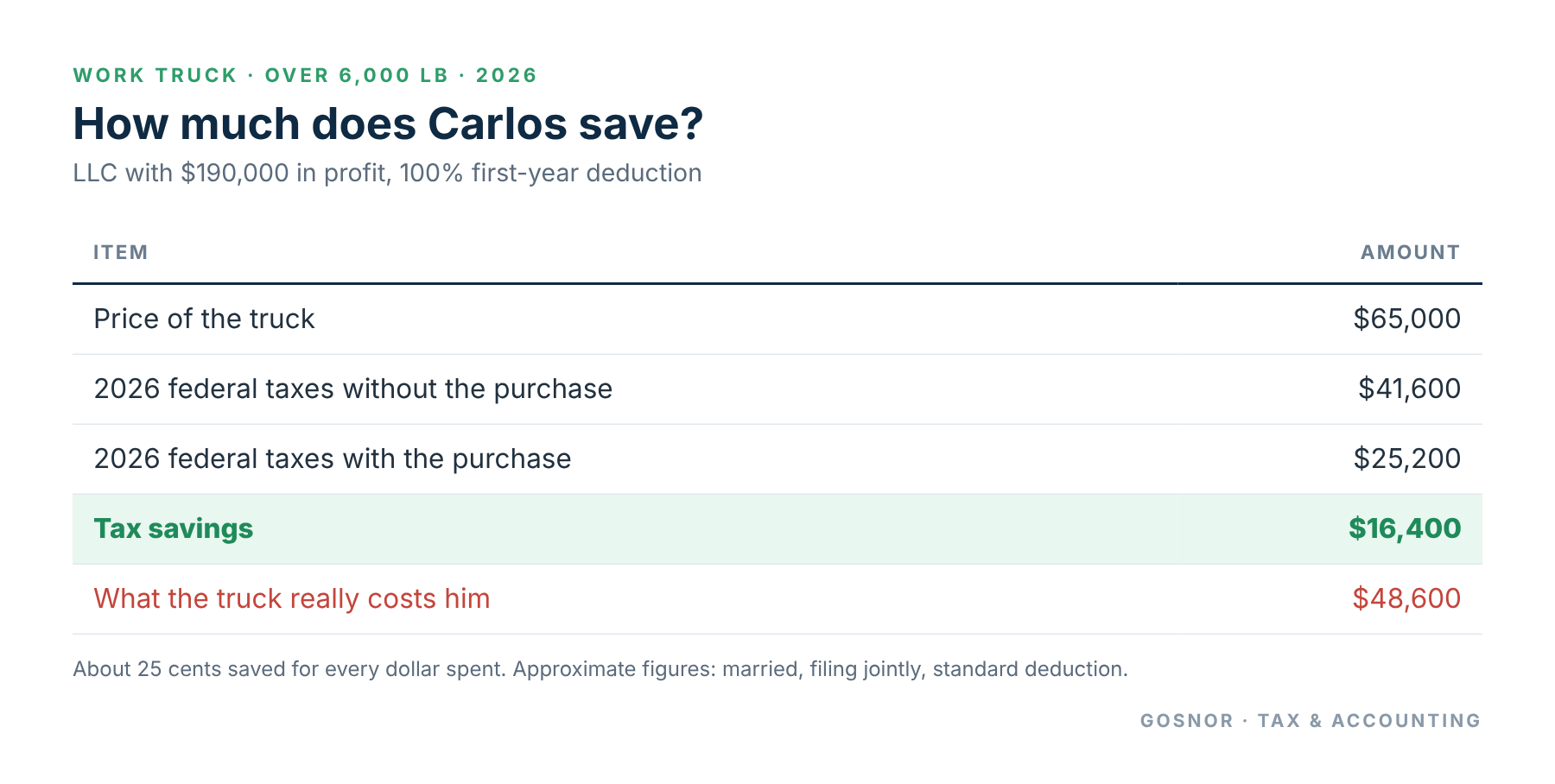
Carlos saves about $16,400 in taxes. But he spends $65,000. For every dollar he spends, he saves about 25 cents.
The deduction doesn’t make the purchase free. It only makes it cheaper. If you don’t need the truck, buying it to pay less in taxes means spending $65,000 to save $16,400.
The fine print
There are also rules worth knowing before you sign:
It has to be in service by December 31. Paying for it or ordering it isn’t enough. The truck has to be delivered and ready to work in 2026.
It has to be used more than 50% for business. And you have to be able to prove it with a mileage log, as we saw in article 2. If business use drops below 50% in a later year, the IRS takes back part of the deduction.
If you sell it, you pay tax on the deduction. If you deduct it in full and sell it two years later for $40,000, that $40,000 becomes taxable income. The deduction doesn’t erase the tax: often it only postpones it.
Not every vehicle qualifies the same way. Cars and lighter SUVs have much lower limits. Before buying, check with your accountant how the vehicle is classified.
Deducting it all now means deducting nothing later. For the next five years, that truck won’t lower your taxes.
The new deduction of up to $10,000 in loan interest isn’t for this truck. You’ve probably heard that you can now deduct up to $10,000 a year in interest on a loan for a new vehicle assembled in the United States. That’s true, but the deduction is only for personal-use vehicles. A truck used more than 50% for business doesn’t qualify. But nothing is lost: the interest on a work truck loan is already a business expense, without that $10,000 limit.
When it does make sense: Carlos’s case
The right question isn’t “How do I pay less in taxes?” It’s “Do I need this truck?” And in Carlos’s case, the answer was yes.
One of his two trucks has more than 210,000 miles, and he was already planning to replace it in the spring. His accountant showed him something he didn’t know: when he buys also matters.
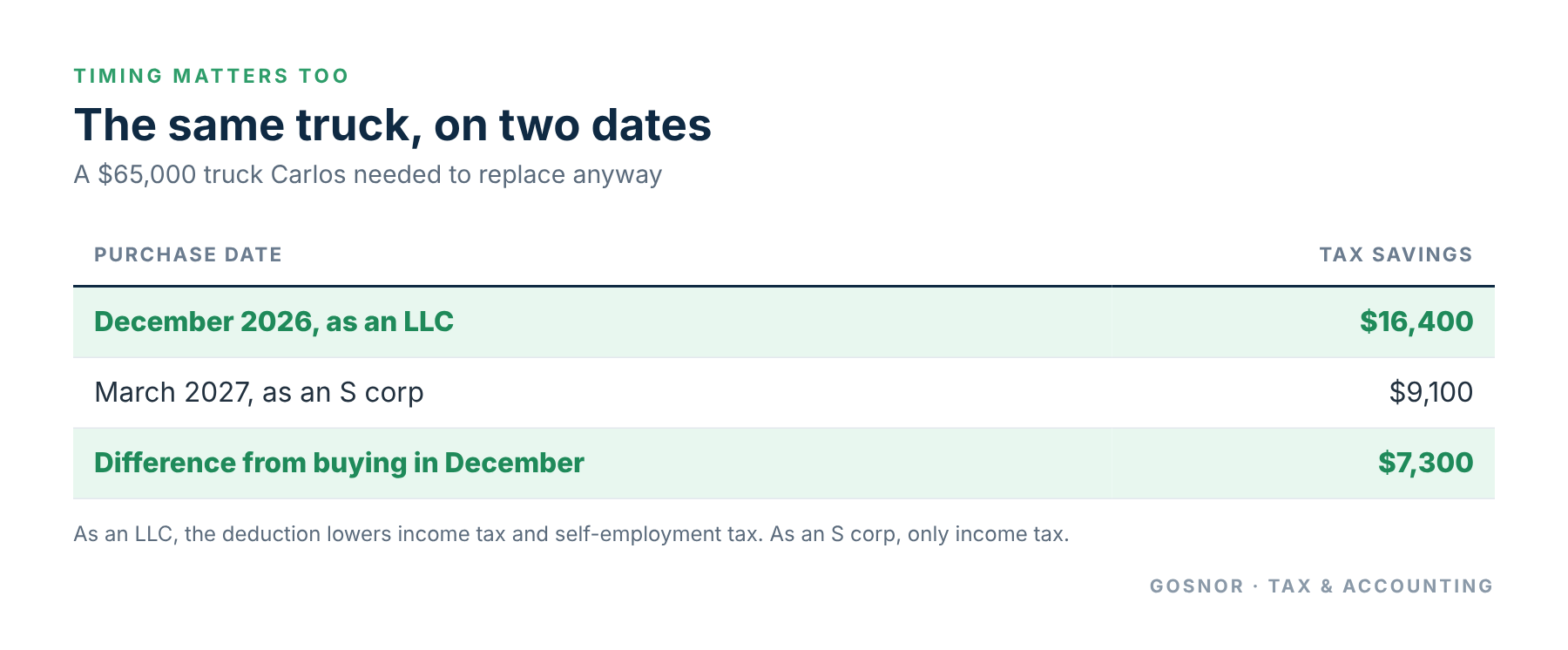
Why the difference? In 2026, the LLC’s profit pays income tax plus self-employment tax. A deduction lowers both. In 2027, as an S corp, Carlos pays payroll taxes on his $85,000 salary, and the deduction no longer touches them. It only lowers his income tax.
Since he needed the truck anyway, moving the purchase up a few months saves him about $7,300 more.
What Carlos decided
Carlos will buy the truck in December, but carefully:
He’s financing it, not paying cash. He can deduct the full cost even while paying it off over time, and that way he doesn’t run out of cash right before April. He already knows what a Friday without money for payroll feels like.
He’ll take delivery and put it to work before Christmas. No waiting until the 31st.
He’ll keep the mileage log from day one.
He won’t touch the tax account. Even though the purchase lowers what he’ll owe, the money set aside for the IRS stays where it is until his accountant finishes the return.
So what now?
A year-end purchase can be a good decision, but only if the business needs it and the cash flow can handle it. Before you buy, ask for the full number: how much you save, what it really costs you, and what happens to your cash.
Next in the series: with the books in order, the S corp ready, and payroll current, a big opportunity shows up for Carlos: a commercial contract that requires a bond. And the bonding company asks for something he never had before: financial statements. We’ll see why having your numbers in order opens doors.
Thinking about a big purchase before year-end? At Gosnor we run the full calculation, with your real profit, before you sign. Book a free consultation.
Lee este artículo en español: "Compra una camioneta en diciembre": la verdad sobre la depreciación y la Sección 179
