
Series: The Numbers Behind Your Business — Part 11 of 15
Starting in January, Carlos will run more payroll than ever: his ten employees, Yoandry and Luis starting in March, and now himself, with his S corp salary. About $11,000 in payroll every Friday.
When his accountant explained how payroll taxes work, Carlos said something many owners think: “Well, if I’m tight one month, I’ll deposit them a little late. The IRS can wait.”
His accountant answered with another story.
Alexis’s story
Alexis has, or had, a plumbing company in Miami with eight employees. Two years ago, the same thing happened to him that happened to Carlos in November: a big client paid in 60 days and the bank account was running low.
Alexis paid his employees every Friday, as always. He withheld taxes from every paycheck, as always. But instead of depositing that money with the IRS, he used it to pay his supplier and his landlord. “I’ll catch up when I get paid,” he thought.
He didn’t get paid in time. Two quarters went by without a deposit. When the first IRS letter arrived, the debt looked like this:
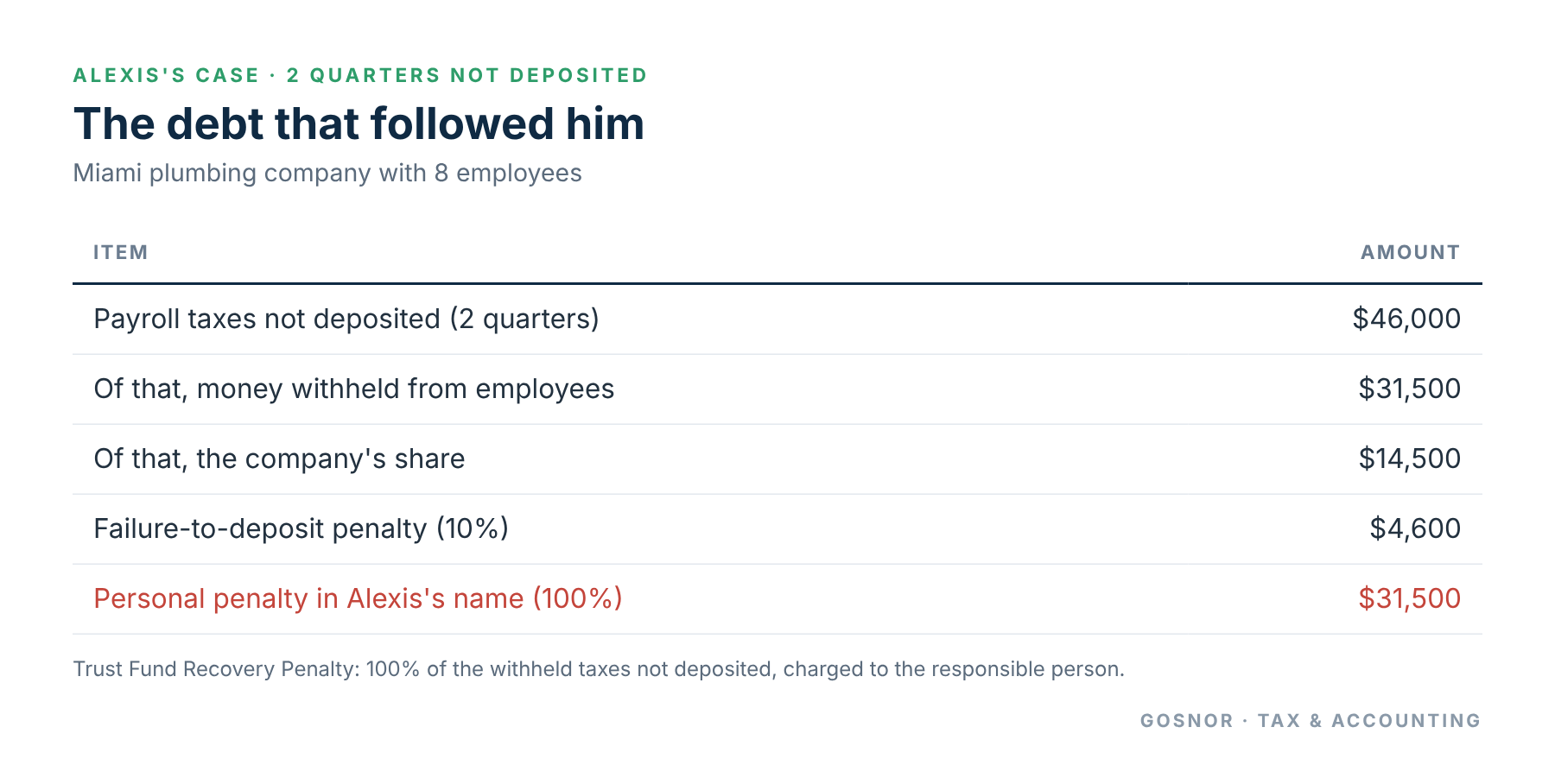
The company ended up closing. But the $31,500 didn’t close with it. The IRS collected it from Alexis personally: it filed a lien on his house and levied his personal bank account.
Why is this debt different from every other one?
Because part of your payroll taxes was never yours.
When you pay an employee, you withhold two things: federal income tax and their share of Social Security and Medicare. That money belongs to the employee. You’re only holding it until you deposit it with the IRS. That’s why the IRS calls them trust fund taxes: taxes you hold in trust.
If you don’t deposit them, the IRS doesn’t see it as just another business debt. It sees it as keeping someone else’s money.
The 100% penalty
To collect that money, the IRS has a tool called the Trust Fund Recovery Penalty. It’s a penalty equal to 100% of the withheld taxes that weren’t deposited, and it’s charged personally to whoever was responsible for paying them.
It doesn’t matter that you have an LLC or a corporation. That protection doesn’t cover you here. And in general, not even bankruptcy wipes it out.
Who can it be charged to? Any responsible person: someone with the authority to decide which bills got paid and which didn’t. It’s almost always the owner, but it can also be a partner or a manager with control over the money.
And when does it apply? When not paying was willful. No bad intent is required. It’s enough to know the taxes were owed and pay someone else first, the way Alexis paid his supplier.
The dates Carlos can’t skip
Payroll has its own calendar, and it’s much tighter than the income tax calendar:
Deposits. Because Carlos’s payroll taxes are over $50,000 a year, he’s what the IRS calls a semiweekly depositor. If he runs payroll on a Friday, the taxes have to be deposited by the following Wednesday.
Form 941. Every quarter, he reports to the IRS what he paid and what he withheld: by April 30, July 31, October 31, and January 31.
Florida reemployment tax. Form RT-6, on the same quarterly dates.
Year-end. W-2s for every employee and Form 940, by January 31.
And if a deposit is late, the penalty grows with the days:
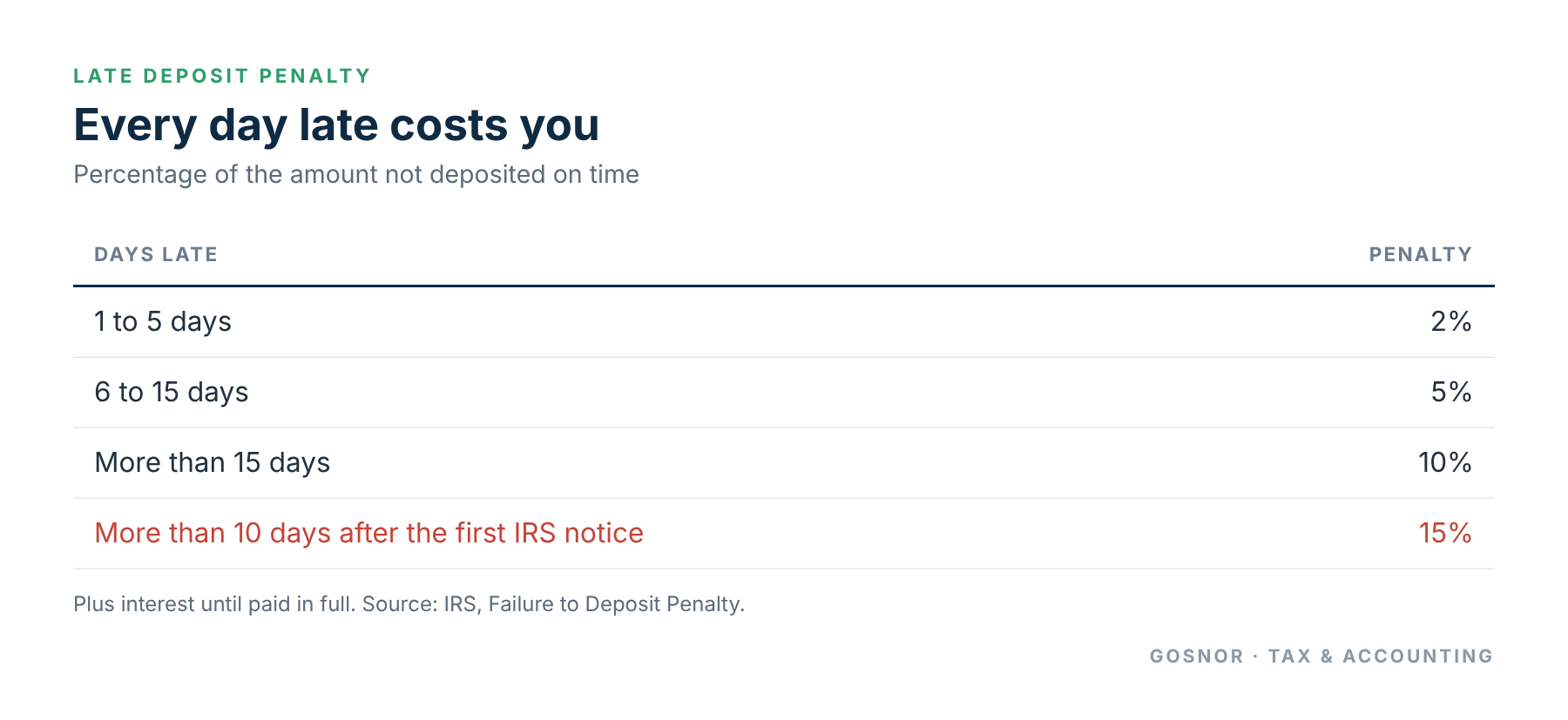
Plus interest, which keeps running until everything is paid.
Carlos’s plan
Carlos doesn’t want to end up like Alexis. With his accountant, he put together a simple plan:
A payroll service that deposits the taxes automatically. The same day payroll is calculated, the service pulls the taxes from the account and deposits them with the IRS.
Check that the deposits were made. Once a month, Carlos logs into EFTPS, the IRS system for tax payments, and confirms everything arrived. If the payroll service makes a mistake, the responsibility is still his.
The tax money is off-limits. If a month is tight, Carlos cuts his own distribution or uses the line of credit. Never the payroll taxes.
Quarterly review. When each quarter closes, his accountant compares the 941 with payroll and the deposits before filing it.
What if you’re already behind?
If you already have late deposits, the worst thing you can do is wait. Every month adds penalties and interest, and the personal penalty becomes more likely.
What you need to do is get current on today’s deposits first, so the debt stops growing, and get professional help to negotiate the back taxes with the IRS, for example through a payment plan. The sooner you act, the more options you have.
So what now?
Payroll taxes aren’t just another bill you can pay late. They’re your employees’ money that you hold for a while. Treat them that way, and they won’t keep you up at night.
Next in the series: December is coming, and Carlos is hearing the usual advice: “Buy a truck before year-end and save on taxes.” We’ll look at the truth about depreciation and Section 179, and when a year-end purchase really makes sense.
Is your business current on payroll taxes? If you have late deposits or a letter from the IRS, Gosnor can help you catch up before it becomes personal. Book a free consultation.
Lee este artículo en español: Impuestos de nómina: la deuda que se puede volver personal
