Series: The Numbers Behind Your Business — Part 3 of 15
Carlos has separated his accounts. He opened a card just for the business, snaps a photo of every receipt, and keeps a mileage log. For the first time, everything that comes in and goes out of his remodeling company is recorded in the right place.
At the end of the month, his accountant handed him three reports. Carlos looked at them and asked what almost everyone asks: “So how do I read this?”
The answer is simpler than it looks. Think of your business as a book. Each report is a different chapter of the same story, and each one answers a different question.
Chapter 1: The Profit and Loss statement (P&L)
The question it answers: did I make money this month?
The P&L (also called the Income Statement) tells you what happened over a period: what you billed, what it cost to do the work, and what was left. Here’s Carlos’s October:
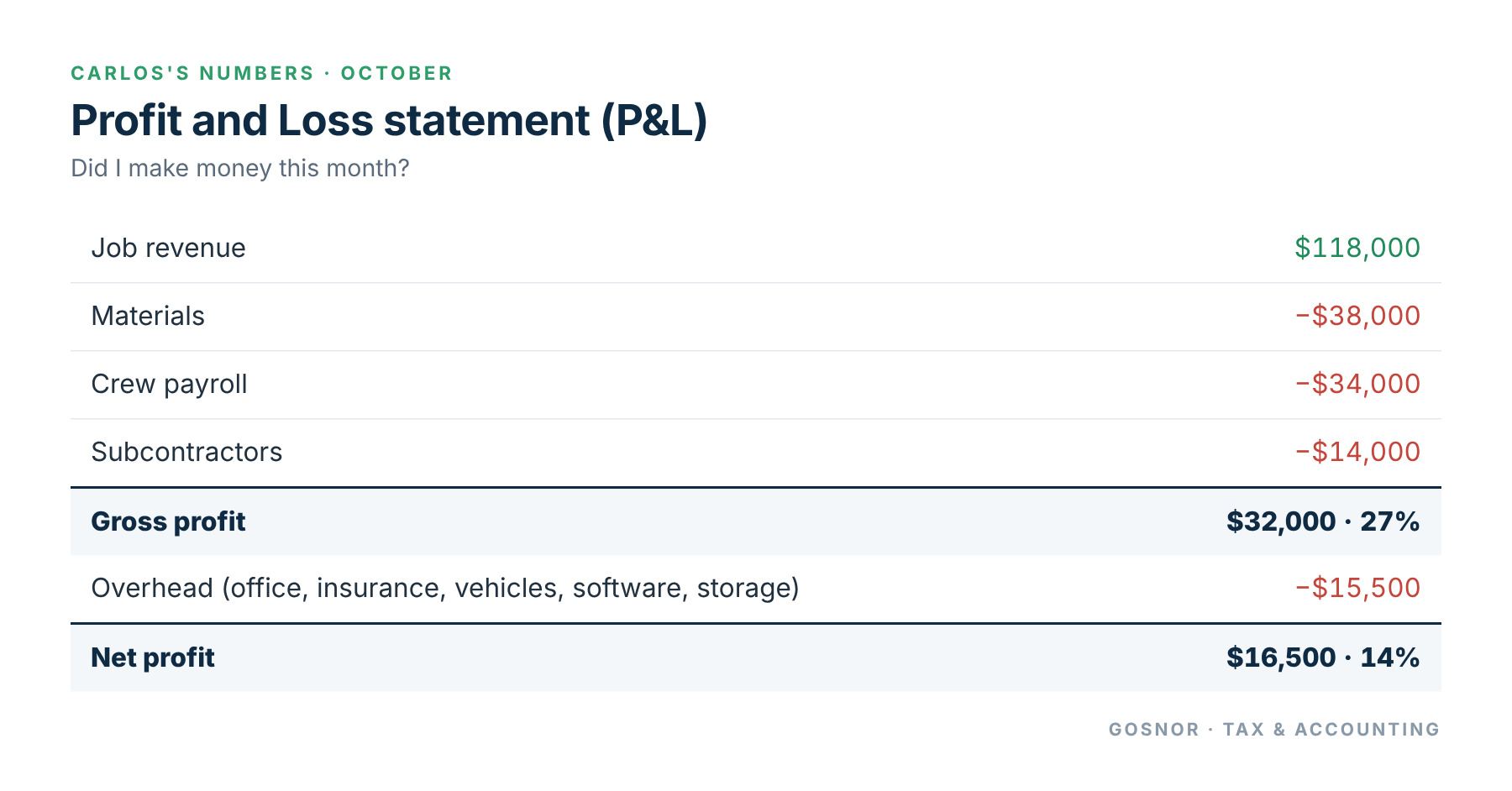
Notice the two profit lines. Gross profit tells you how much your jobs leave you after paying what it costs to do them. Net profit tells you what’s left after also paying everything it costs to keep the business running.
Carlos billed $118,000, but kept 14 cents of every dollar. That isn’t good or bad on its own. What matters is that he now knows it, and can compare it month to month.
Chapter 2: The Balance Sheet
The question it answers: what do I have, what do I owe, and what’s really mine?
If the P&L is a movie of what happened during the month, the Balance Sheet is a snapshot of a single day. Here’s where Carlos stood on October 31:
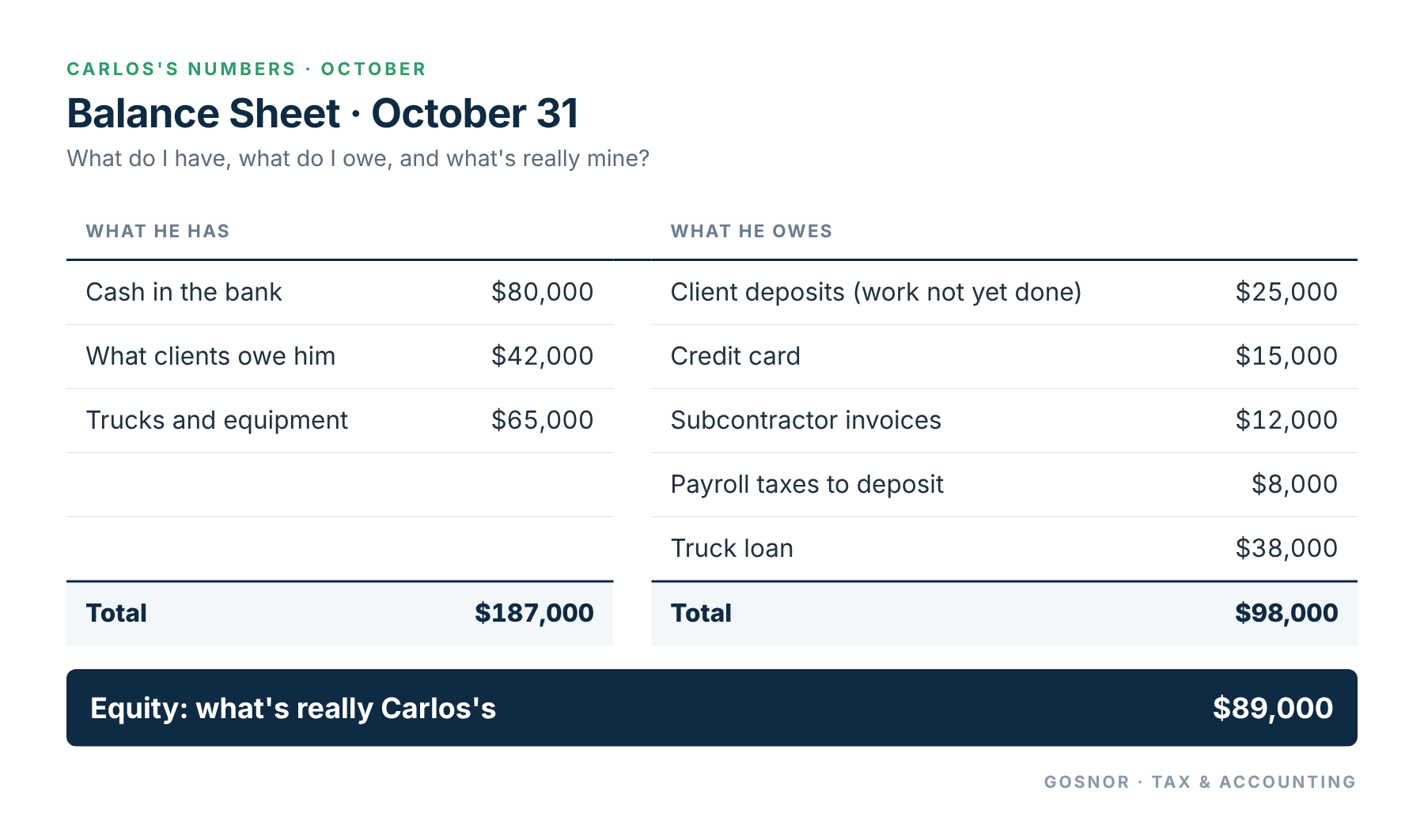
The difference between what he has and what he owes, $89,000, is what actually belongs to Carlos inside the business. Accountants call it equity.
Recognize some of those numbers? They’re the same ones from the first article: the $80,000 in the bank, the $25,000 deposit, the $15,000 card balance. The Balance Sheet is the report that would have shown Carlos, at a glance, that the money wasn’t all his.
Chapter 3: The Cash Flow statement
The question it answers: where did the money come from, and where did it go?
This is the report that surprises business owners most. Carlos made $16,500 in October, but his bank account didn’t go up $16,500. It went up $9,000. Why?
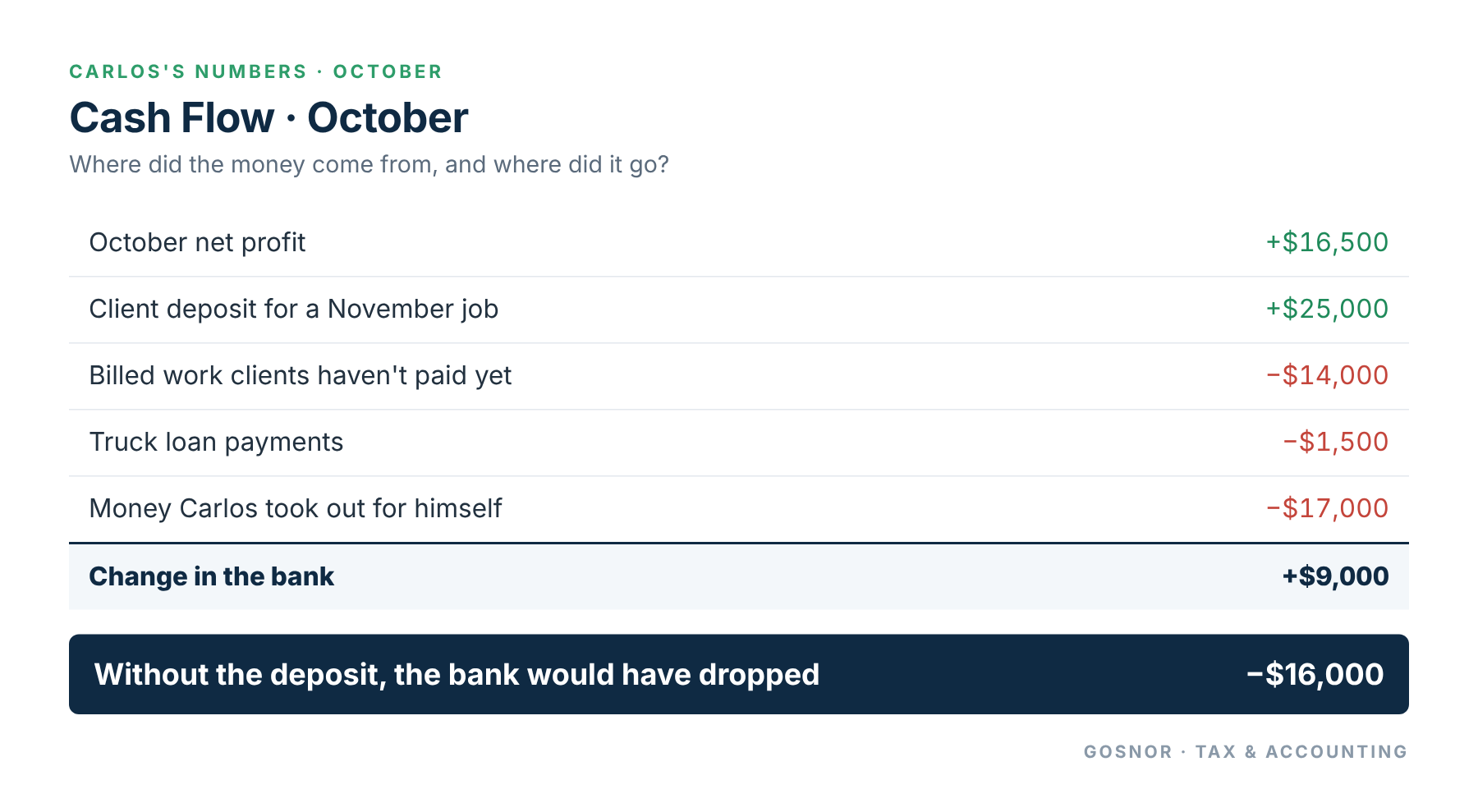
Here’s the most important lesson: Carlos’s account went up thanks to a deposit he hasn’t earned yet. Without that deposit, his bank balance would have dropped $16,000 in a month when he made a profit.
You can’t see that in the P&L. You can’t see it in the bank balance either. Only the cash flow statement shows it.
Why you need all three
Each report on its own tells only part of the story, and can mislead you:
The P&L tells you whether you make money, but not whether you’ll have cash for Friday’s payroll.
The Balance Sheet tells you what you have and what you owe, but not how you got there.
The Cash Flow statement tells you where the money went, but not whether the business is profitable.
Together, they give you the whole story. And they’re also the first thing a bank, a bonding company, or a large client will ask for before giving you a contract.
So what now?
You don’t need to prepare these reports yourself. But it’s worth spending 15 minutes a month reading them. Three questions are enough to start: how much did I keep of what I billed? How much of what’s in the bank is really mine? And why did my account go up or down this month?
Next in the series: Carlos’s month without that deposit. We’ll see why businesses that make money still run out of cash, and how to keep it from happening to you.
Do you get these three reports every month? If not, at Gosnor we’ll prepare them and help you understand them. Book a free consultation.
Lee este artículo en español: Los tres reportes que cuentan la historia de tu negocio
