
Series: The Numbers Behind Your Business — Part 4 of 15
On November 1, Carlos had $80,000 in the bank. His accountant had already explained that not all of it was his, but he still felt calm. October had been a good month, he had two big jobs underway, and the phone kept ringing.
Three weeks later, on Thursday night, November 19, Carlos was staring at his banking app with a knot in his stomach. The next day he had to make a $9,000 payroll. And there wasn’t enough in the account.
The strangest part is that November was a month with $19,000 in profit.
How can you make money and run out of cash at the same time?
Because profit and cash move on different schedules. The P&L records the work when it’s done and billed. The bank only finds out when the client pays. And expenses almost always arrive before the payments do.
Here’s Carlos’s month, week by week:
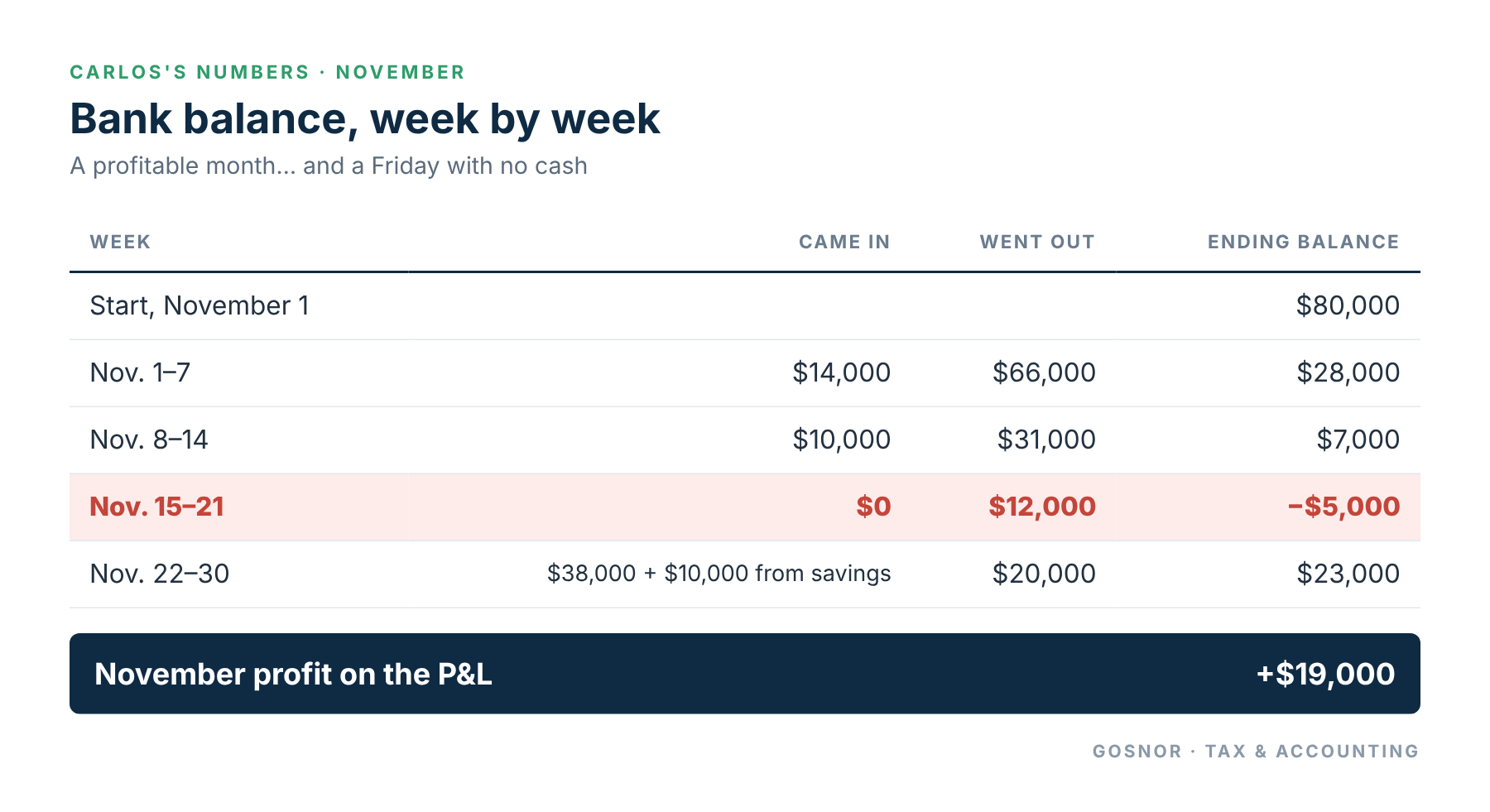
What happened?
The first week, he paid October’s bills. The credit card, the subcontractors, and the payroll taxes: $35,000 he already owed. He also bought $22,000 in materials for the $75,000 remodel, using the deposit the client gave him in October. That deposit was already part of the $80,000; it wasn’t new money.
The second week, he started a commercial job: a $95,000 dental office build-out. He bought $18,000 in materials. But that client pays in 45 days, and also holds back 10% of every payment until the job is finished in February. In construction, that’s called retainage.
The third week, nothing came in. Payroll kept going out every Friday, as always. On Thursday the 19th, Carlos was $5,000 short of paying his crew.
Carlos covered payroll with $10,000 from his personal savings. In the last week, a $38,000 progress payment came in and the account recovered. But nobody can give him back that Thursday night.
The money didn’t disappear: it’s on its way
If you look at Carlos’s Balance Sheet on November 30, the money is there. It’s just not in the bank:
About $47,000 the dental office owes him and will pay in December.
About $9,500 in retainage he won’t see until February.
The materials for the big job, which turn into cash as the work progresses and he bills for it.
The business is healthy. The problem is the calendar. And that’s why so many profitable businesses close: not for lack of profit, but because one Friday there wasn’t cash to pay.
And remember the warehouse. In the first article, Carlos was about to sign a five-year lease. If he had, November’s gap would have had one more rent payment on top, every single month.
How to avoid Carlos’s Thursday
It’s not about making more money. It’s about seeing the gap coming and getting ready.
Build a cash flow projection. A simple table of what you expect to come in and go out each week for the next three months. With it, Carlos would have spotted the week-3 problem back on November 1.
Negotiate how and when you get paid. Ask for deposits, bill by project stage, and invoice the same day you finish each stage. On commercial jobs, review payment terms and retainage before you sign, not after.
Open a line of credit before you need it. Banks lend more easily when you’re not desperate and your financial statements are in order.
Keep a reserve. A reasonable goal is to keep one to two months of payroll and fixed costs in the bank, separate from job money.
Don’t take money out based on your bank balance. Base it on real profit and your projection. We’ll talk about that in Article 6.
So what now?
Profit tells you whether your business works. Cash flow tells you whether it will survive next Friday. You need to watch both.
Next in the series: The dental office looked like the best contract of the year. We’ll see how much it really left Carlos, and how to know what each job earns you before you bid the next one.
Do you know how much cash you’ll have a month from now? At Gosnor, we help you build a cash flow projection so no Friday catches you by surprise. Book a free consultation.
Lee este artículo en español: Ganancia vs. flujo de caja: por qué negocios que ganan dinero se quedan sin efectivo
