Series: The Numbers Behind Your Business — Part 8 of 15
Carlos has heard about the S corp everywhere. A friend told him he saved “a ton.” A video on social media promised he’d “pay half the taxes.” And in Article 6 we saw that, in theory, he could save money on self-employment tax.
So Carlos asked his accountant for what every owner should ask for before deciding: the full numbers. Not just what he saves, but also what it costs.
First: what changes with an S corp?
An S corp isn’t a new kind of company. It’s a way for the IRS to treat your LLC for tax purposes. Carlos keeps the same LLC, with the same legal protection. What changes is how he gets paid and how he pays taxes:
Carlos goes on payroll. He gets a salary with a W-2, with taxes withheld like any employee.
That salary has to be reasonable. What someone would be paid to do his job. For Carlos, who manages 10 employees, prices jobs, and handles clients, his accountant recommended $85,000.
The rest of the profit comes out as distributions. Carlos pays income tax on distributions, but not Social Security or Medicare.
That’s where the savings come from. Now let’s look at the numbers.
Carlos’s numbers: LLC vs. S corp
With the same $190,000 in profit and the same assumptions as the last article (married, filing jointly, standard deduction):
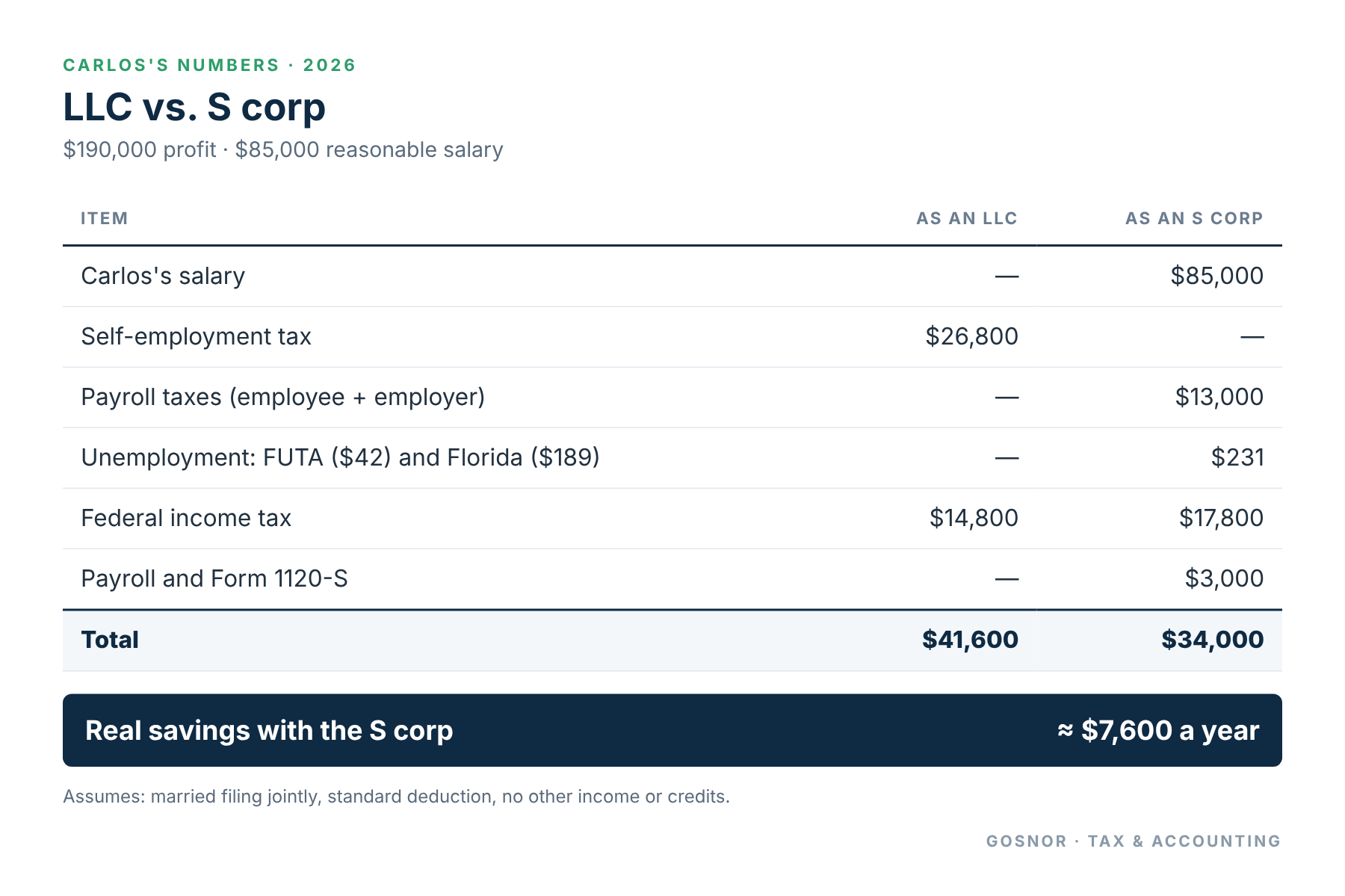
Real savings: about $7,600 a year.
That’s good money. But notice it’s not half the taxes, and not even the $13,800 you’d see if you only compared self-employment tax to payroll taxes.
Why are the savings smaller than people say?
Because of three things almost nobody mentions:
1. Income tax goes up. As an LLC, Carlos gets a 20% deduction on his business profit, the QBI deduction. As an S corp, the deduction still applies to the profit left in the S corp, but not to his $85,000 salary. The result: he pays about $3,000 more in income tax.
2. The S corp costs money. It needs a payroll service all year, with quarterly filings and a W-2, plus a separate tax return, Form 1120-S. All in, about $3,000 a year, depending on who prepares it. These costs are deductible, and that tax benefit is already included in the income tax shown in the table.
3. There are payroll taxes that didn’t exist before. Federal unemployment tax (FUTA, $42 a year) and Florida reemployment tax ($189 a year) on Carlos’s salary. They’re small, but they add up.
And there’s a fourth point that isn’t money today, but you should know it: since Carlos will pay into Social Security on $85,000 instead of his full profit, his Social Security retirement benefit could be somewhat lower in the future.
When does it make sense, and when doesn’t it?
An S corp usually makes sense when:
Profit is high and steady, not one good year. As a starting point for the conversation, many accountants start looking at it when profit is consistently above roughly $70,000 to $80,000 a year.
The owner can run payroll every month and pay a truly reasonable salary.
The books are in order: separate accounts, categorized expenses, monthly reports.
And it usually doesn’t make sense when:
Profit is low or swings a lot from year to year.
The owner still mixes personal and business expenses.
The only reason is “to pay less,” without being willing to follow the payroll rules.
So what did Carlos decide?
Carlos has high, steady profit, has already separated his accounts, and is keeping his books current. With net savings of about $7,600 a year, he decided to elect S corp status starting January 1, 2027. For it to apply from that date, his accountant has to file Form 2553 no later than March 15, 2027.
But before taking the step, Carlos had a question: “What if I pay myself a lower salary? Wouldn’t I save more?”
Next in the series: reasonable salary. What the IRS looks at in an S corp, what happened to a friend of Carlos’s who paid himself a $30,000 salary, and why the most expensive trap is not taking a salary at all.
Does an S corp make sense for you? At Gosnor, we run the full numbers on your real profit, costs included, before you decide. Book a free consultation.
Lee este artículo en español: ¿LLC o S corp? Los números completos, sin promesas exageradas
