
Series: The Numbers Behind Your Business — Part 5 of 15
When Carlos signed the dental office contract, he celebrated. $95,000, a commercial client, a job that looked great in his portfolio. It was the biggest contract he’d landed all year.
In the last article we saw how that job squeezed his cash flow. Now we’ll look at something worse: how much it’s really going to leave him.
How Carlos priced the job
Carlos did what many contractors do. He estimated what materials, labor, and subcontractors would cost: about $79,000. He added 20% “for profit” and got $94,800. He rounded up to $95,000.
He thought he’d make 20%. He had two problems and didn’t know it.
Problem 1: the real costs weren’t the estimate
Using the costs from the first few weeks and what’s left to do, his accountant put together the job’s expected final cost:
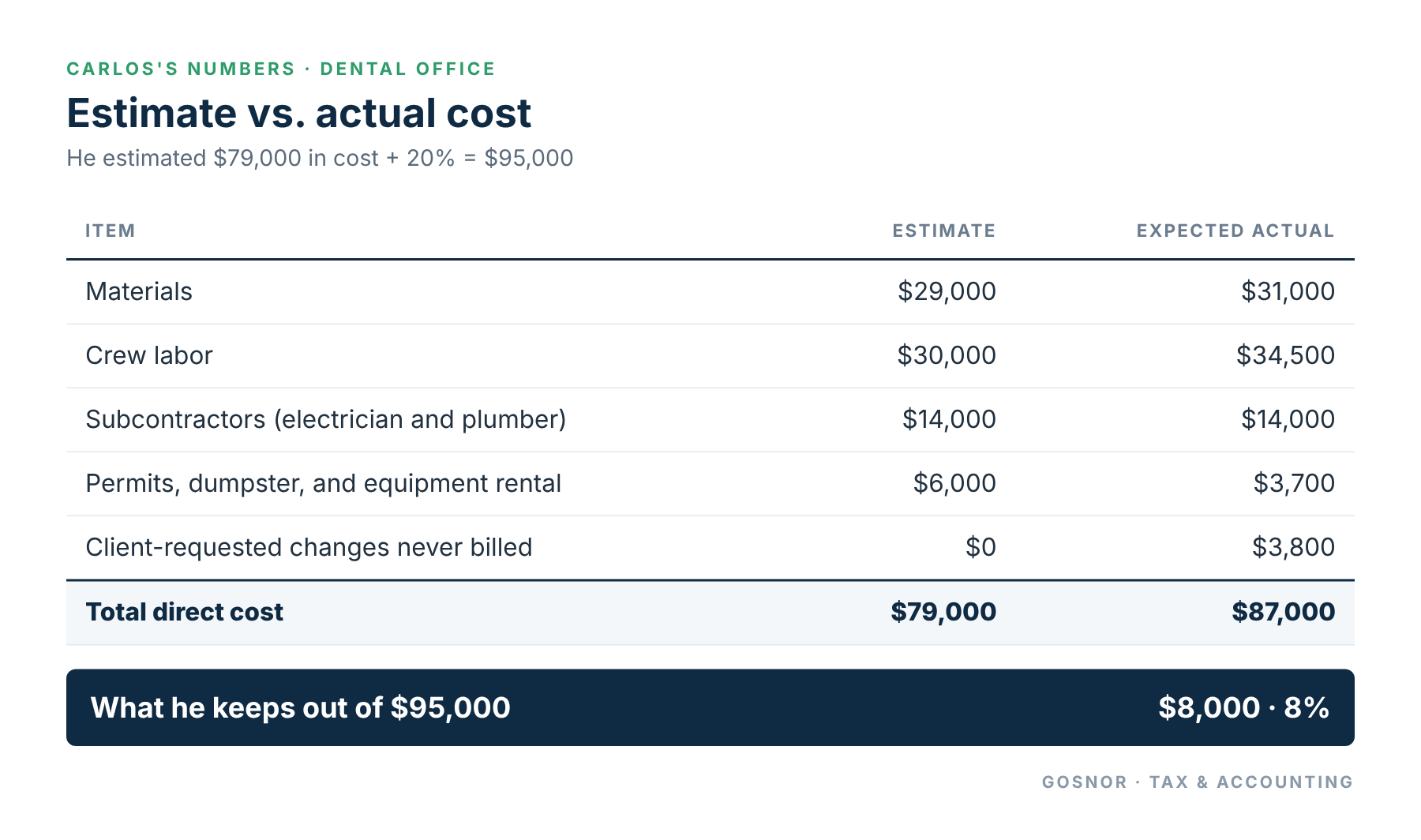
The crew took longer than planned waiting on inspections. And the client asked for “a couple of small changes”: move a sink, add an outlet. Carlos did them in good faith, without a written change order, and never billed for them.
Out of $95,000, after direct costs, he keeps $8,000. Not 20%. 8%.
Problem 2: he forgot the business costs money even when there’s no job
The office, insurance, trucks, software, storage: Carlos spends about $15,500 a month keeping the business open. With two crews, that’s roughly $1,800 for every week each crew works.
The dental office will tie up one full crew for 8 weeks. That’s $14,400 in overhead the job has to cover.
The final math on the dental office:
Contract: $95,000
Direct costs: −$87,000
Overhead for 8 weeks: −$14,400
Result: −$6,400
The biggest contract of the year is going to lose him money.
Meanwhile, the other crew
During those same 8 weeks, Carlos’s second crew did five residential bathroom remodels, at about $17,500 each.
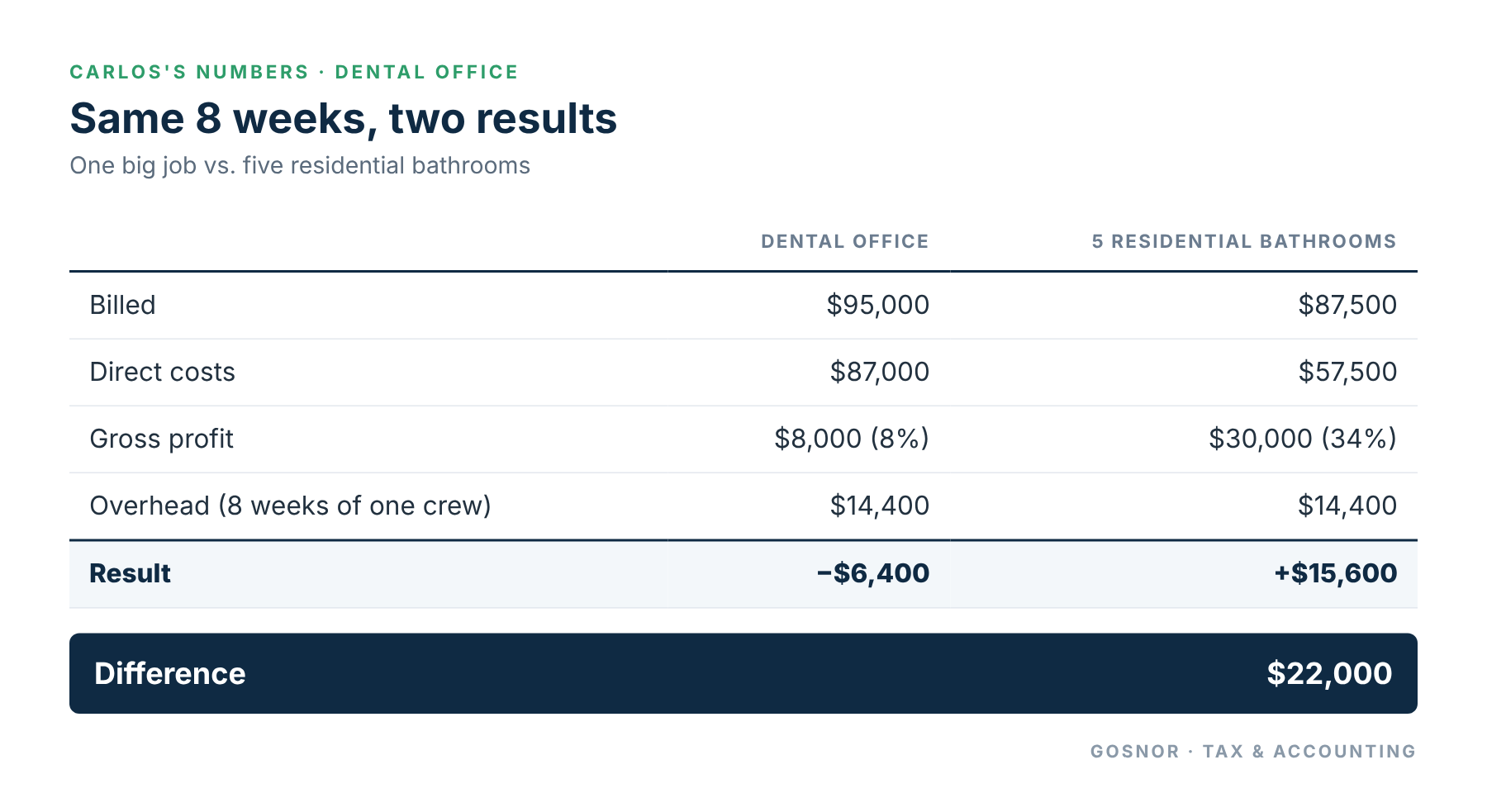
Nearly the same revenue. The same amount of time. A $22,000 difference.
And on top of that, the bathrooms get paid with a deposit and on completion, with no 45-day wait and no retainage.
Markup is not the same as margin
There’s a math mistake that costs a lot of contractors a lot of money. If you add 20% to a $100 cost, you charge $120. But your profit isn’t 20% of what you charged: it’s $20 out of $120, or 16.7%.
To keep 20% of what you charge, you have to add 25% to cost.
To keep 30%, you have to add 43%.
And that’s still before overhead.
How to know what each job makes you
Track costs by job, not just by month. Every materials invoice, every crew hour, and every subcontractor payment gets assigned to the job it belongs to. Accounting software does this with projects or “classes.”
Calculate your overhead cost per week. It’s the number that turns a nice-looking estimate into a real price.
Price with this formula: direct costs + overhead for the weeks the job will take + the profit you want. With that formula, the dental office should have been priced at about $110,000.
Every change order in writing, with a price. Before you do it, not after.
When each job ends, compare the estimate to the actual. It’s the best training for pricing the next one.
So what now?
Billing a lot feels good. But what pays your payroll, your taxes, and your mortgage is what each job leaves you. When you know what each type of job makes you, you can decide which ones to take, how much to charge, and which ones to pass on.
Next in the series: For years, Carlos has taken money out of the business “whenever he needs it.” We’ll talk about how you pay yourself, and the question that leads many owners to consider an S corp.
Do you know which of your jobs make money and which don’t? At Gosnor, we help you track costs by job so you can price with real numbers. Book a free consultation.
Lee este artículo en español: ¿Cuánto te deja cada trabajo? El contrato más grande del año puede ser el que te hace perder dinero
