
Series: The Numbers Behind Your Business — Part 13 of 15
In January, Carlos got the biggest opportunity of his career. A developer he had worked with before offered him the remodel of three medical offices in Doral: $420,000 and four months of work. More than twice his biggest job so far.
There was one condition: the contract required a performance and payment bond.
Carlos called a bonding agent. The agent’s first question wasn’t about his experience or his crews. It was this: “Can you send me your financial statements?”
What is a bond, and why do they ask for one?
A bond is a guarantee. A surety company promises the project owner that if Carlos doesn’t finish the job or doesn’t pay his suppliers and subcontractors, it will take care of it.
It’s not insurance for Carlos. If the surety has to pay, it comes after him afterward. That’s why, before issuing a bond, the surety looks closely at whether Carlos can deliver. And that shows up in the numbers.
What the agent asked for
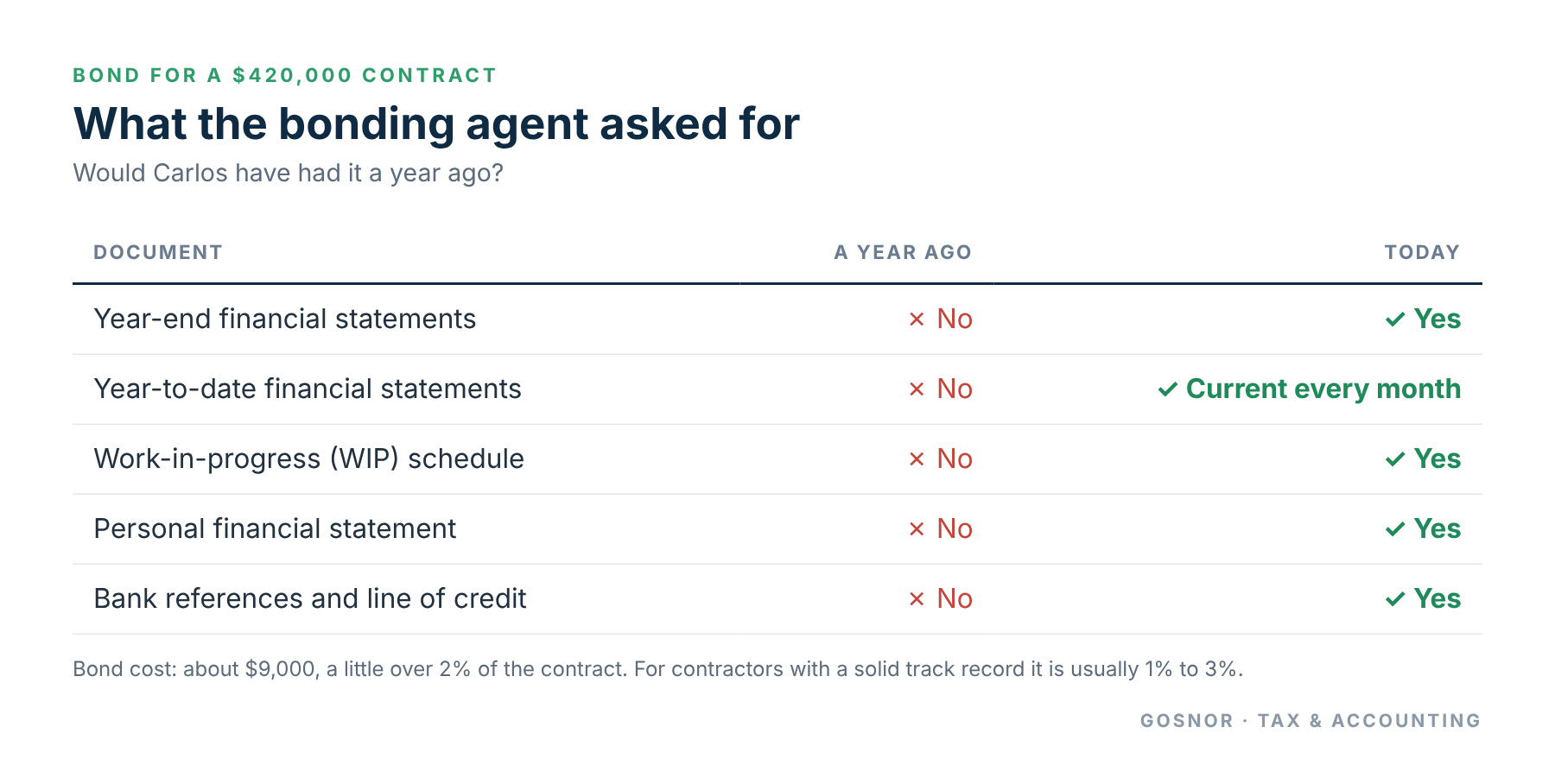
The list the agent sent looked like this:
Last year’s financial statements, as of December 31: the balance sheet, the income statement, and the cash flow statement.
Year-to-date financial statements, to see how the business is doing now.
A work-in-progress (WIP) schedule: what each contract is worth, how much has been spent, how much is left, and how much has been billed.
A personal financial statement for Carlos.
Bank references and the details of his line of credit.
A year ago, Carlos couldn’t have sent almost anything on that list. His numbers were in a shoebox and in a bank account mixed with his household’s, as we saw in article 2. Today his books are current every month, he has the job profitability report from article 5, and he has a line of credit. He put it all together in two days.
What they look at in the numbers
Sureties focus on three things above all:
Working capital: what the business has in the short term (cash and receivables) minus what it owes in the short term. It’s the cushion to carry a big job while payments come in.
Net worth: everything the business owns minus everything it owes.
Profit and track record: whether the business makes money consistently and whether its jobs finish the way they were estimated.
This is the balance sheet Carlos presented, simplified:
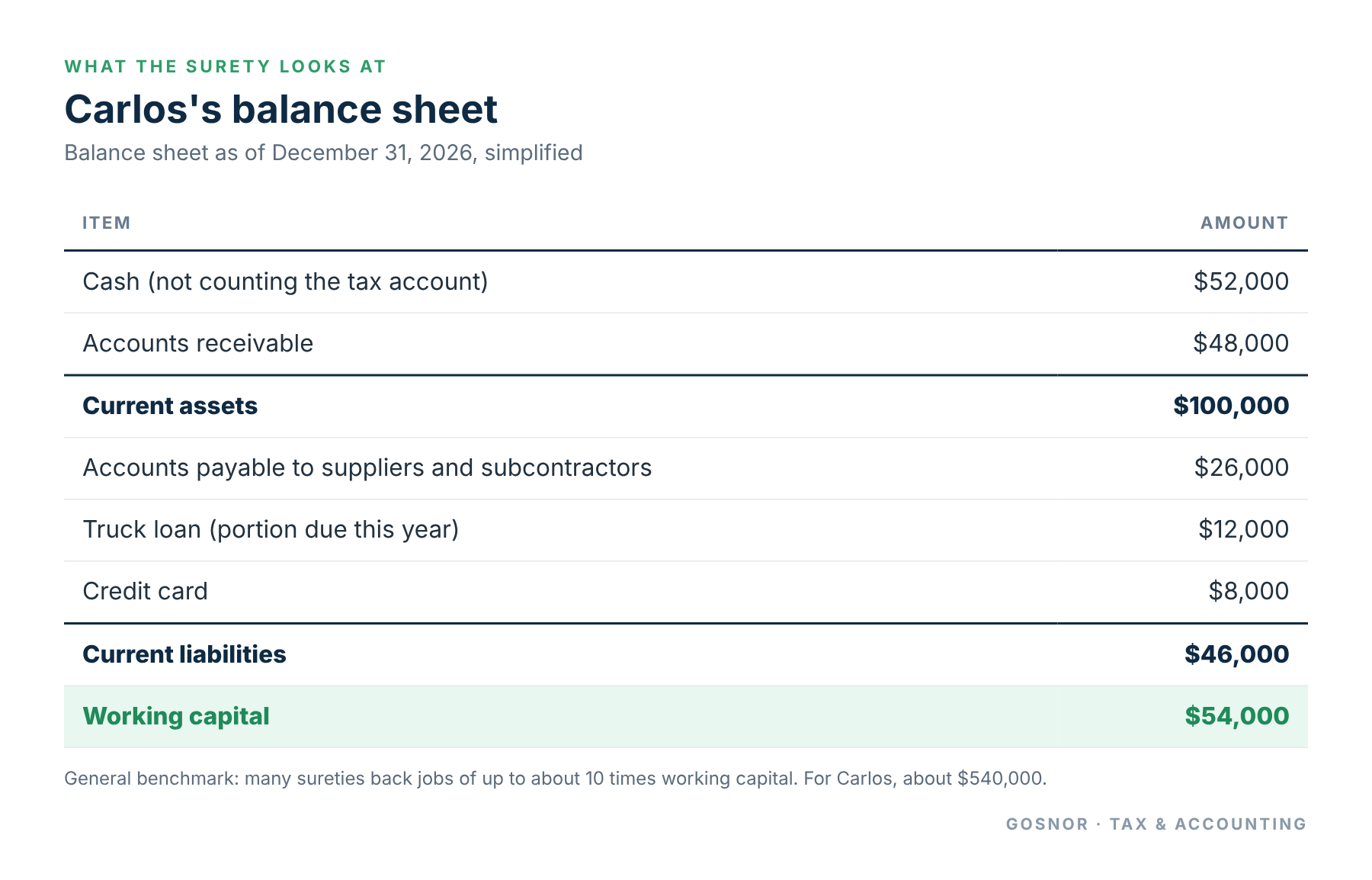
As a general benchmark, many sureties back jobs of up to about 10 times a contractor’s working capital. For Carlos, that’s around $540,000. The $420,000 contract fit.
Two details almost nobody knows
Tax money doesn’t count. Carlos had more cash, but part of it was in the tax account from article 7. That money already has an owner, the IRS, and it can’t back a job. Presenting it as available cash would have inflated the numbers.
The truck is still worth money. In article 12, Carlos deducted the full truck on his 2026 taxes. On the return it’s worth zero. But in the financial statements for the surety, it’s shown as what it is: an asset that loses value little by little. That’s why a business’s financial statements aren’t the same as its tax return.
The answer
A week later, the surety approved Carlos. The bond cost him a little over 2% of the contract, about $9,000, and he built it into his bid price. For contractors with good numbers and a solid track record, the cost is usually between 1% and 3%.
Before receiving it, Carlos had to sign a personal indemnity agreement. If something goes wrong and the surety has to pay, it can come after him, his business, and his personal assets. A bond is a door that opens, but it’s also a responsibility.
Not just for bonds
Even if you never need a bond, sooner or later someone will ask for your financial statements:
The bank, for a loan or a line of credit.
A big client or a general contractor, before giving you an important job.
A landlord, before signing your lease.
A buyer, the day you want to sell your business.
If your numbers are current, that moment is a two-day task. If not, it’s an opportunity lost while you try to rebuild a year of receipts.
So what now?
Keep your books current every month, not just in April. Keep business and personal accounts separate. And know your balance sheet, not just your income statement. It’s the report banks and sureties look at most, and the one owners review least.
Next in the series: in February, Carlos finds a letter from the IRS in his mailbox. We’ll look at what to do, and what not to do, if the IRS comes knocking.
Being asked for financial statements? At Gosnor we keep your books current and prepare your financial statements every month, ready for the bank, the surety, or your CPA. Book a free consultation.
Lee este artículo en español: Cuando te piden estados financieros: la puerta que abren tus números
