Series: The Numbers Behind Your Business — Part 14 of 15
One Tuesday in February, Carlos opened his mailbox and saw a white envelope with the Treasury Department logo. Inside was a letter from the IRS about his 2024 return. At the bottom, in bold, a number: $2,400, plus interest.
The first thing he felt was what almost everyone feels: a knot in his stomach. The second was something new for him: calm. Because this time he knew where to look.
First: is it really the IRS?
Before doing anything, you need to know how the IRS really contacts people, because scammers take advantage of fear:
The IRS almost always contacts you first by mail, through the U.S. Postal Service.
It doesn’t call out of the blue demanding immediate payment, and it doesn’t threaten to have you arrested or deported.
It doesn’t ask you to pay with gift cards, cryptocurrency, or transfers to a person. Payments go only to the “United States Treasury” or through IRS.gov.
It doesn’t send you direct messages on social media.
In-person visits are rare and almost always come after several letters. The IRS employee carries two official credentials with a photo and serial number.
If you’re unsure, don’t use the phone number from the call or message. Log in to your account at IRS.gov or call the official number listed on the IRS website.
Second: read the letter calmly
Every IRS letter has three pieces of information that matter:
The notice number, in the top right corner (for example, CP2000 or CP14). It tells you what kind of letter it is.
The tax year it’s about.
The response deadline. Careful: the days are counted from the date printed on the letter, not from the day you open it.
Carlos’s was a CP2000. It’s not an audit. It’s a notice that the information the IRS received from others, like 1099s or W-2s, doesn’t match what you reported. And it’s a proposal: the IRS tells you how much it thinks you owe, and you can accept it or show that it’s wrong.
Carlos’s case
One of his clients, a property management company, sent him a 2024 Form 1099-NEC for $48,000. Carlos had reported $40,000 from that client. To the IRS, $8,000 was missing.
A year ago, that would have meant days digging through a shoebox. But when Carlos got his books in order, his accountant also organized the invoices, bank statements, and returns from prior years. This time he found the answer in five minutes:
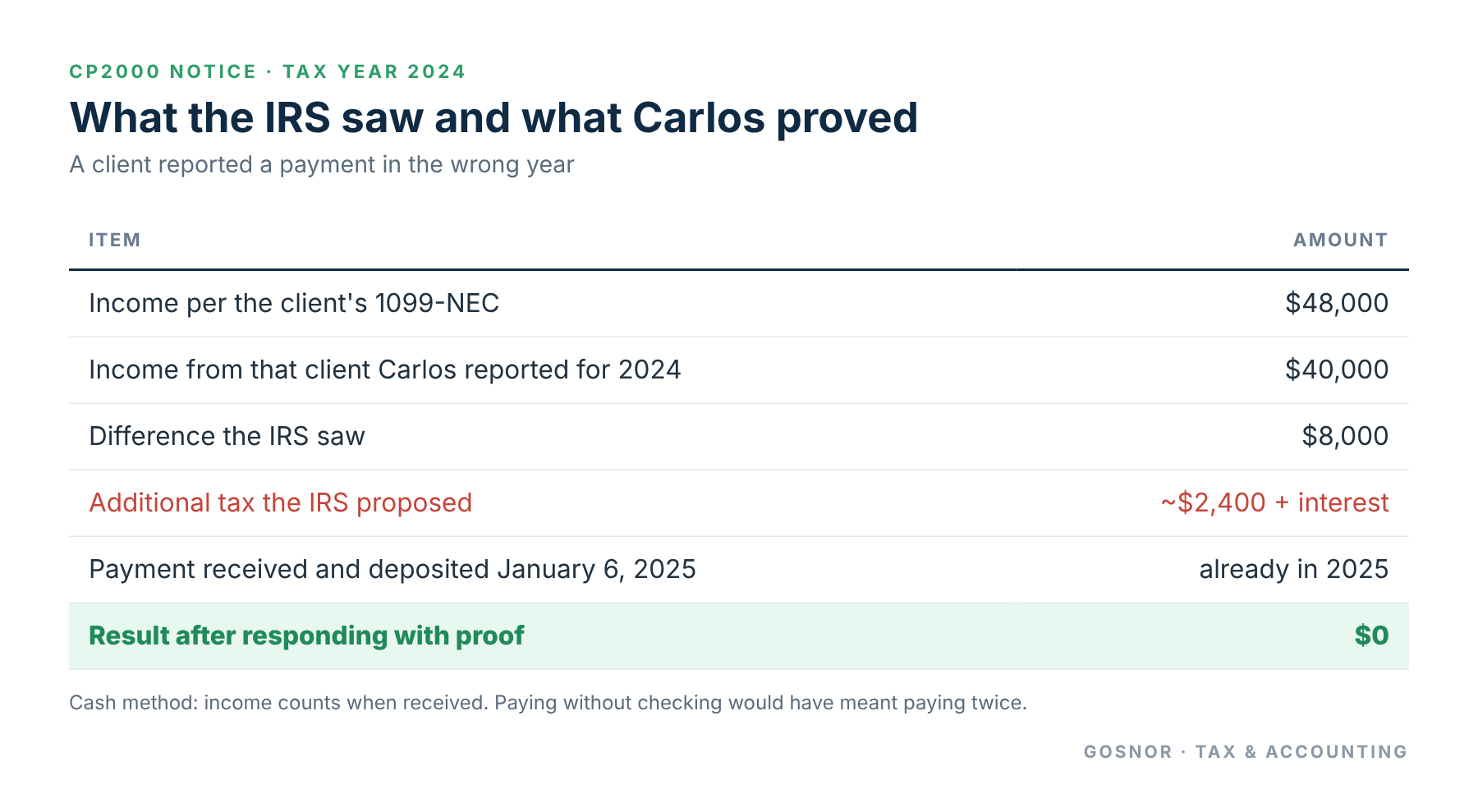
The client had paid him that $8,000 with a January 2025 check but put it on the 2024 1099. Carlos keeps his books on the cash method: income counts when it’s received. That $8,000 was already on his 2025 return. If he had paid without checking, he would have paid tax twice on the same money.
How he responded
With help from his accountant, Carlos:
Checked the box on the response form saying he disagreed.
Wrote a short letter explaining the difference.
Attached the proof: the invoice, a copy of the check dated January 2025, and the bank statement showing the deposit.
Asked the client for a corrected 1099, so the mistake wouldn’t happen again.
Sent it by certified mail to the address on the letter, before the deadline, and kept a copy of everything.
A few months later, another IRS letter arrived: they accepted the explanation. Balance: zero.
What not to do
Don’t ignore the letter. If you don’t respond, the IRS assumes it’s right and the process keeps moving.
Don’t pay without checking. A notice is a proposal, not a verdict. The IRS is often wrong or missing information.
Don’t call without the paperwork in front of you. First understand what they’re telling you.
Don’t respond angrily or with long explanations. A short, clear letter with proof is worth more than ten pages.
The most common letters
Not all letters are the same. These are the ones business owners receive most:
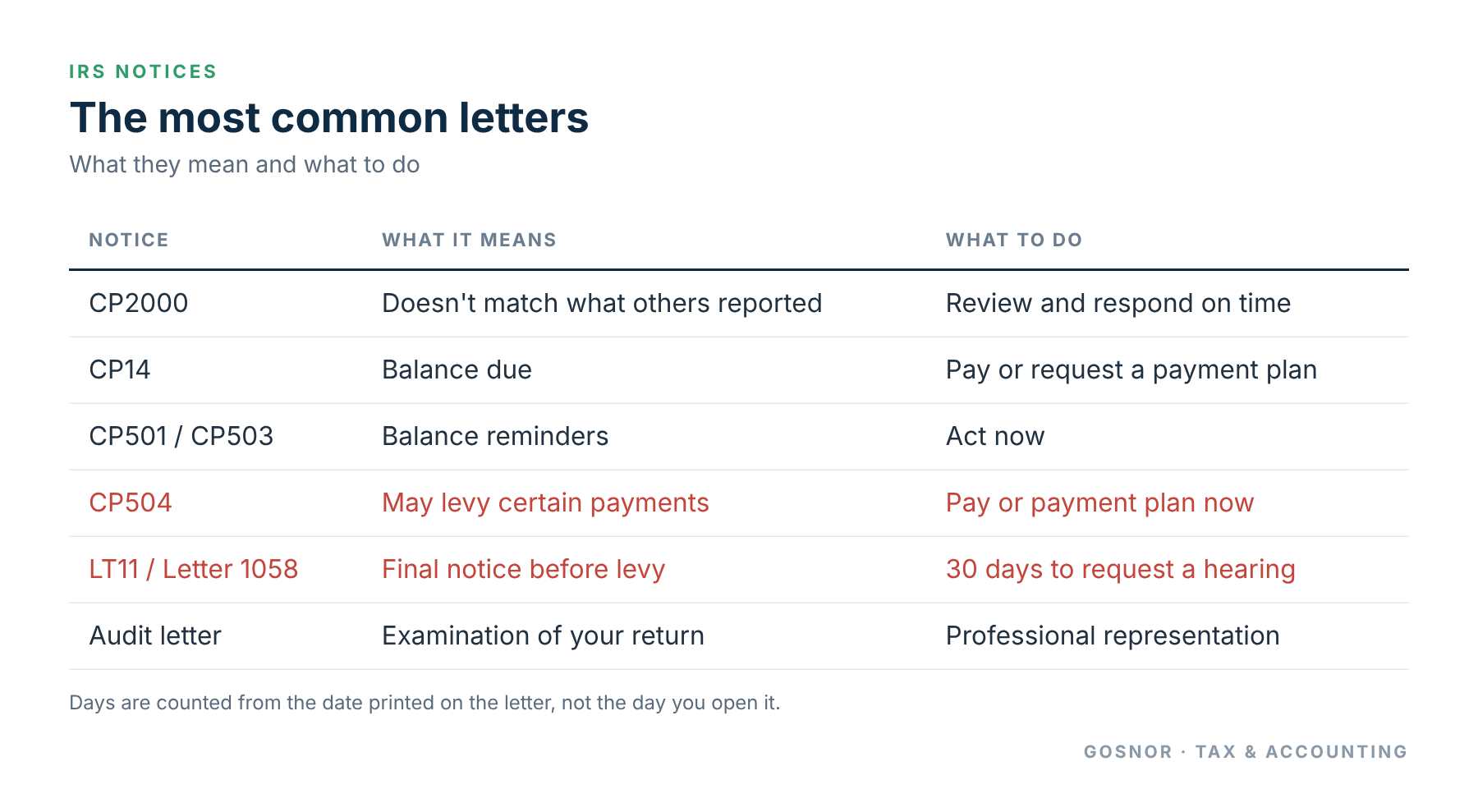
If your case is an audit or a debt in collections, it’s best to be represented by a professional authorized to practice before the IRS: an Enrolled Agent, a CPA, or a tax attorney.
So what now?
The best defense with the IRS isn’t prepared the day the letter arrives. It’s prepared every month, with current books, separate accounts, and every invoice and deposit in its place. That way, when the IRS asks, you have the answer.
Next in the series: we close the series. Carlos looks back at a full year of changes and does the final math: how much keeping his books in order cost him, and how much it saved him. We’ll see why accounting isn’t an expense.
Got a letter from the IRS and not sure what it means? At Gosnor we help you understand it and keep your books and documents in order. And if your case needs representation before the IRS, we’ll refer you to an authorized professional. Book a free consultation.
Lee este artículo en español: Si el IRS toca a tu puerta: qué hacer y qué no hacer
